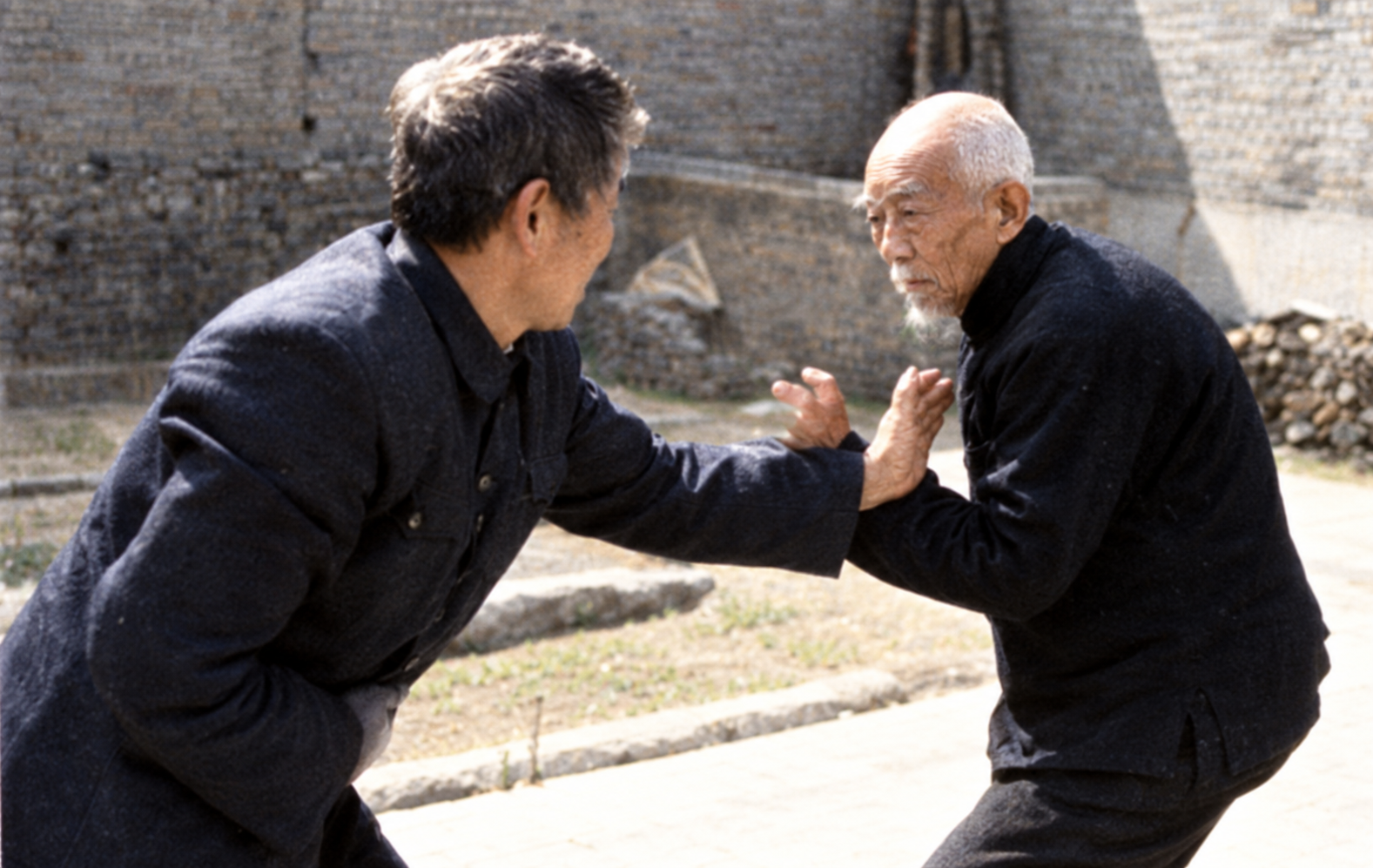
Wu Dianke practicing with his student (digitally restored and colourised)
Who created Xingyi Quan? The answers preserved within its traditions lead us through stories of Buddhist patriarchs, patriotic generals, wandering spear experts and manuscripts discovered in ruined monasteries. These accounts are part of the art’s inheritance, but understanding their historical value requires us to ask when they were recorded, what evidence supports them and how they have changed through transmission.
The article translated below, “Investigating the Origins of Xingyi Quan” (形意拳探源), by Wu Dianke and Wu Lianru, examines three familiar founding figures: Bodhidharma, Yue Fei and Ji Jike. Its authors reject the first two attributions and argue that Ji should be recognised as the person who brought together earlier methods to establish Xinyi Liuhe Quan, the ancestral art from which Xingyi Quan subsequently developed. They also take a definite position on a disputed question: did Ji Jike learn martial arts at Shaolin, or did he transmit his own art there?
I have preserved this article as a two-page clipping from a popular Chinese martial arts magazine, which I recall being published in the 1990s. While I still have the clippings themselves, I cannot recall the magazine title, issue and exact year it was published.
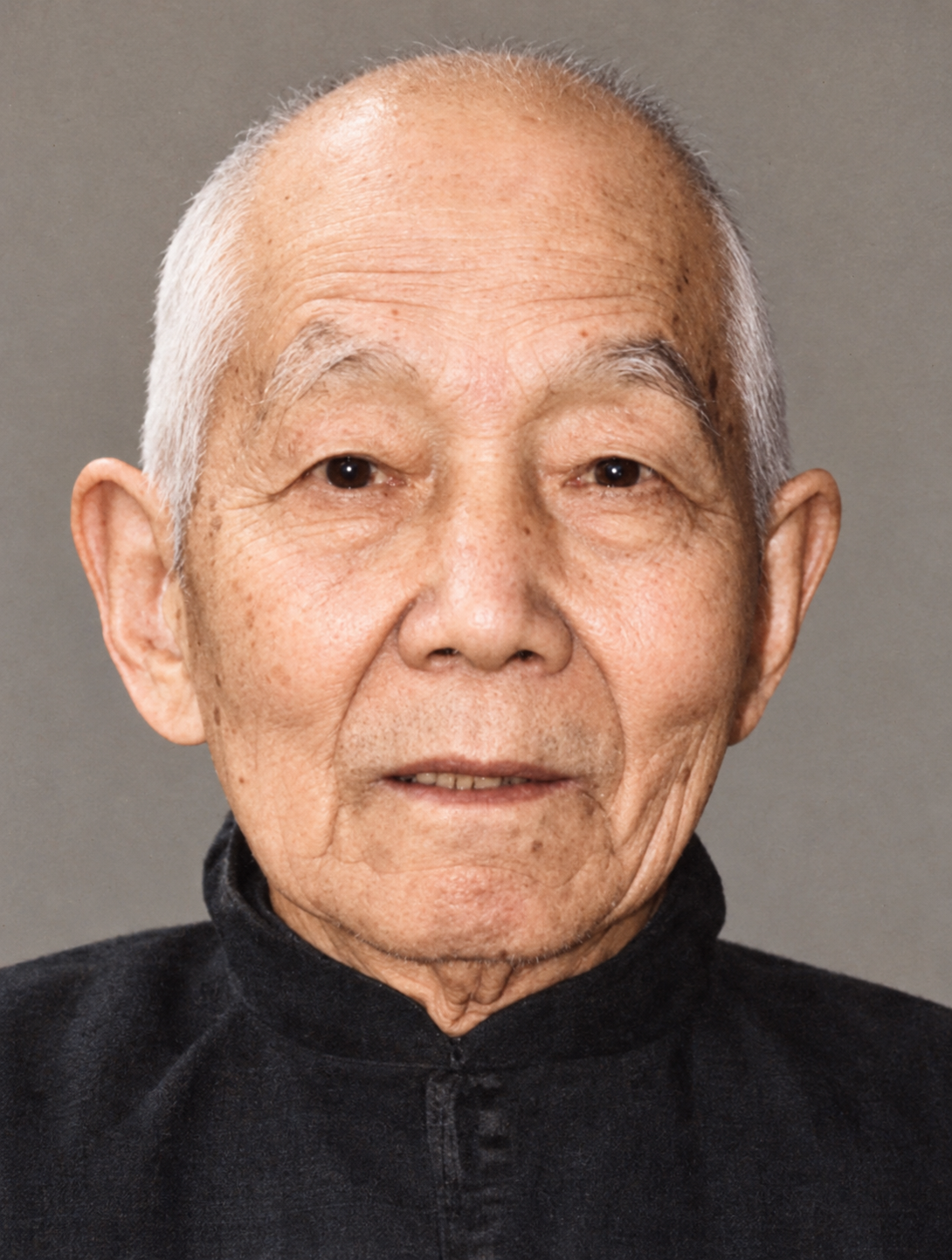
Wu Dianke (1911-2003) (digitally restored and colourised)
Wu Dianke and His Place in the Tradition
Wu Dianke (1911–2003) was a prominent representative of Shanxi Xingyi Quan and its Che-lineage traditions. Born in Taigu, he began training under his elder brother, Wu Yaoke, to improve his health. As a teenager he studied for four years under Bu Xuekuan, a noted disciple of Che Yizhai, and also received guidance from Li Fuzhen, Li Guangheng and Che Zhaojun. In 1932 he became a disciple of Liu Jian, one of Che Yizhai’s later disciples, who became his principal teacher.
Wu’s contribution extended beyond his own practice and teaching. In 1950 he compiled a Xingyi boxing manual, and he later served as chief editor of the widely circulated 1993 volume Xingyi Quan Shu Da Quan, a comprehensive collection on the art. His writings helped preserve and disseminate material from the Shanxi tradition.
Readers of this blog may already recognise his name from my article “The Mystery of the Photograph of Guo Yunshen”. There, I presented a translation of Jia Chi’s examination of the famous photograph of Guo Yunshen and Che Yizhai, including the controversy over its reversed reproduction and disputed captions in Wu’s publication. As I noted in my closing comments, Jia Chi’s own account also displays some bias. Scrutiny must apply to criticism as well as to the claims being criticised.
That discussion provides useful context here. Wu’s experience and contribution deserve recognition, while his historical arguments should be assessed through the evidence he presents. His place within the Che lineage helps us understand his perspective, but does not by itself explain or invalidate any particular conclusion. This article was also co-authored by Wu Lianru, whose contribution should not be overlooked.
Several questions raised here are discussed in my book, Dragon Body, Tiger Spirit – A Translation and Explanation of the Classic Texts of Xingyi Quan, particularly in the biographies of Yue Fei, Ji Jike and Cao Jiwu, and my commentary on the classical texts. Jarek Szymanski’s contributed historical essay in that volume offers a further, separately authored examination of the early transmission. I return to these connections after the translation.
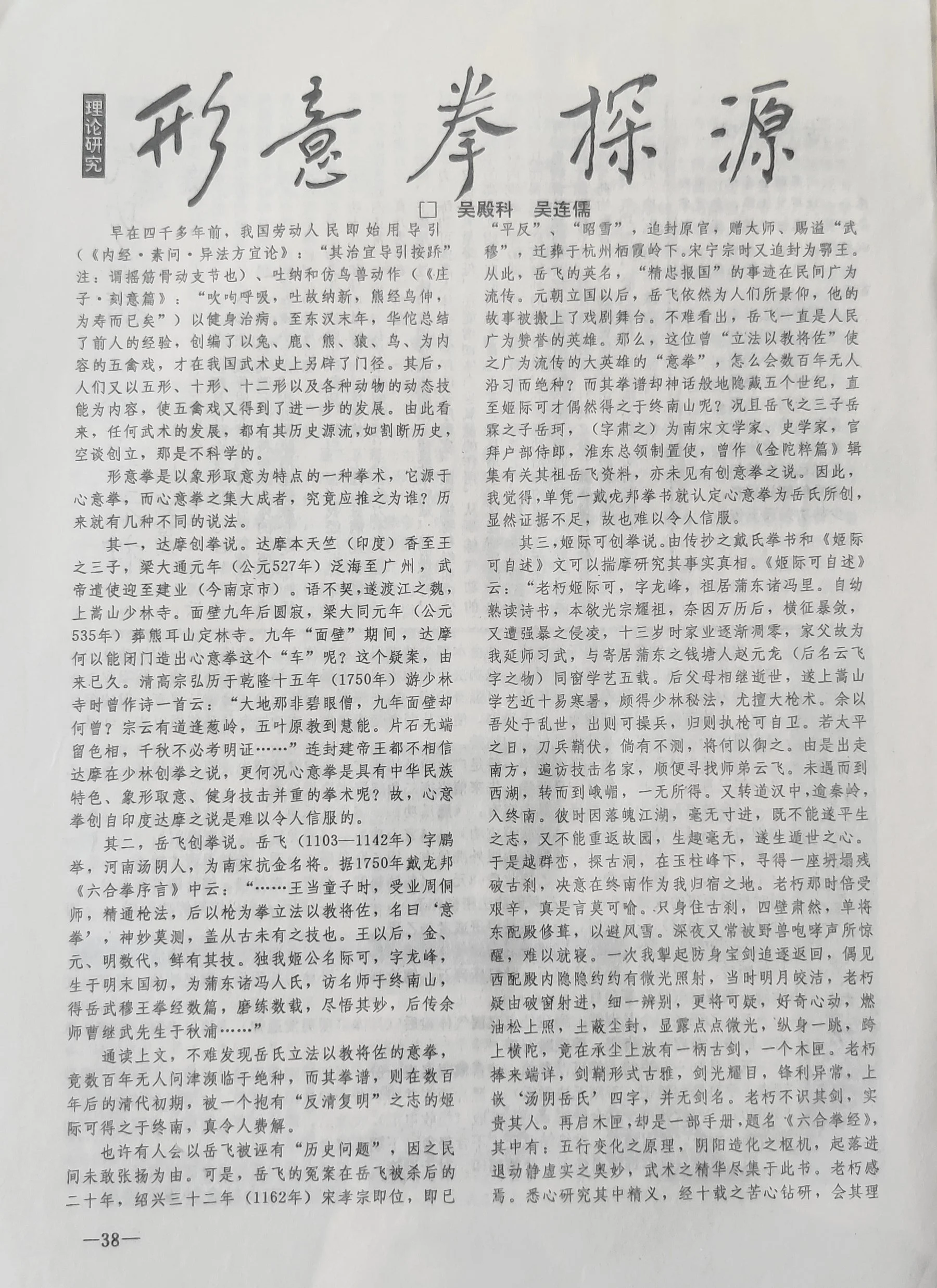
The original article pg.1
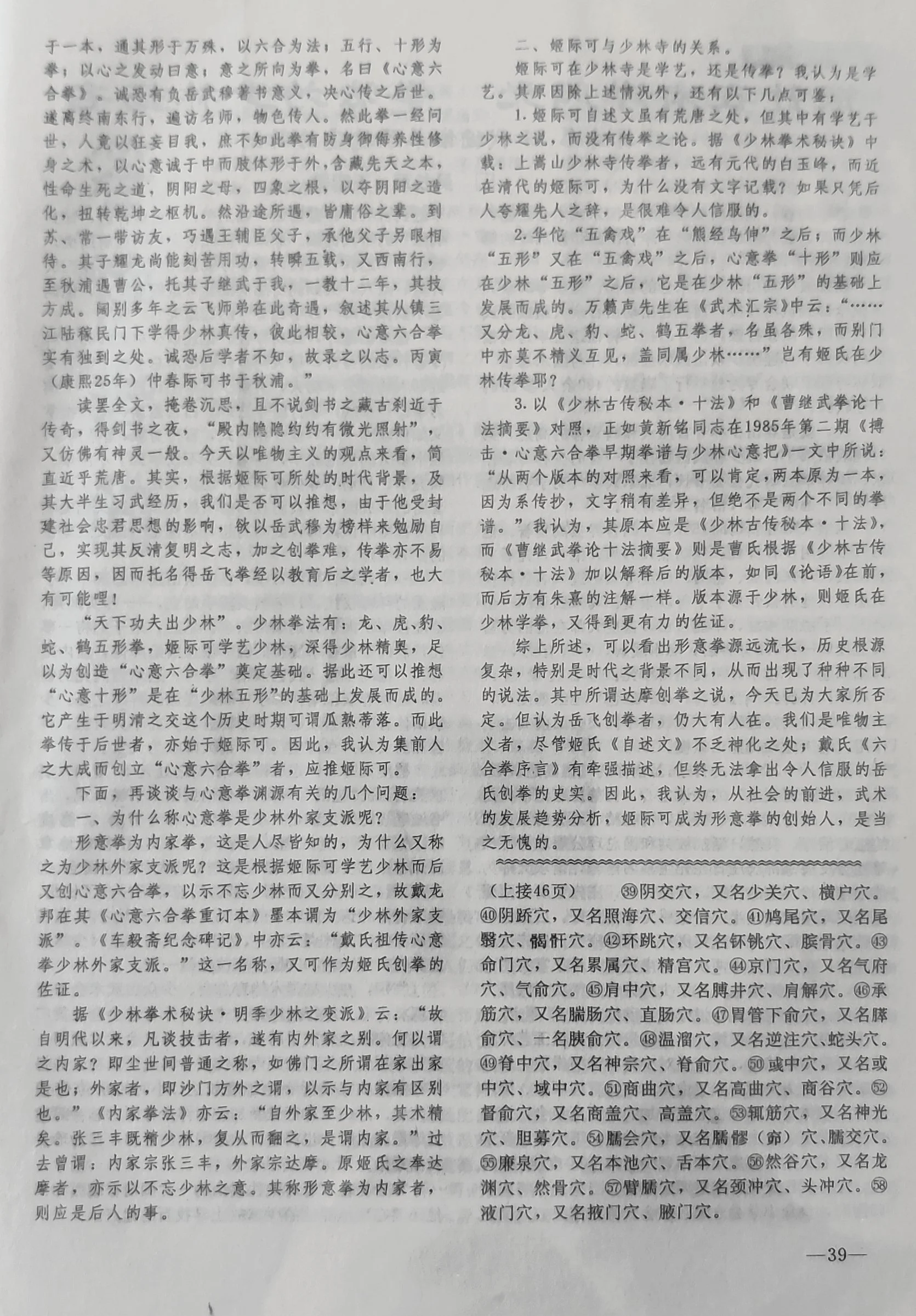
The original article pg.2
Investigating the Origins of Xingyi Quan
Authors: Wu Dianke (吴殿科) and Wu Lianru (吴连儒) - Translated by Byron Jacobs
As early as more than four thousand years ago, the working people of China were already using daoyin exercises, breathing practices, and movements imitating birds and animals to maintain health and treat illness. The “Discourse on Different Methods and Appropriate Treatments” in the Basic Questions of the Inner Canon states: “Their treatment should appropriately employ daoyin and massage.” The accompanying explanation describes this as moving the sinews and bones and mobilising the joints. The “Constrained Will” chapter of the Zhuangzi similarly speaks of “exhaling and inhaling, expelling the old and drawing in the new, stretching like a bear and extending like a bird, solely to attain longevity.”
Towards the end of the Eastern Han dynasty, Hua Tuo drew together the experience of his predecessors and devised the Five Animal Frolics, comprising movements based on the tiger, deer, bear, monkey and bird.[1] This opened another avenue in the history of Chinese martial arts. Subsequently, people incorporated the Five Forms, Ten Forms, Twelve Forms, and the movements and abilities of various animals, further developing the Five Animal Frolics. From this perspective, every martial art has its historical origins and development. To sever those historical connections and speak abstractly of its creation is unscientific.
Xingyi Quan is a martial art characterised by imitating forms and drawing out their underlying intent. It derives from Xinyi Quan. But who should be recognised as the person who brought Xinyi Quan together into a comprehensive system? Several different explanations have circulated over time.
The Theory That Bodhidharma Created the Art
Bodhidharma was originally the third son of King Xiangzhi of India. In the first year of the Datong reign of the Liang dynasty, corresponding to 527 CE, he travelled by sea to Guangzhou. Emperor Wu sent an envoy to welcome him to Jianye, present-day Nanjing. Their conversation proved incompatible, so he crossed the Yangtze into the territory of Wei and went to the Shaolin Monastery on Mount Song.
After nine years of facing a wall, he passed away. In the first year of the Liang dynasty’s Datong reign, corresponding to 535 CE, he was buried at Dinglin Monastery on Mount Xiong’er.
How could Bodhidharma have shut himself away during those nine years of “wall-facing” and invented this particular “wheel”, Xinyi Quan? This question has long been disputed. In the fifteenth year of the Qianlong reign, 1750, the Qing emperor Gaozong, whose personal name was Hongli, visited Shaolin Monastery and composed a poem:
Where on this great earth was the blue-eyed monk not present?
When did he ever spend nine years facing a wall?
The tradition says he was encountered on the road at the Congling Mountains;
The five leaves were originally a teaching reaching down to Huineng.
A slab of stone needlessly preserves an outward likeness;
Through a thousand autumns, there is no need to seek conclusive proof …
Even a feudal emperor did not believe the claim that Bodhidharma created boxing at Shaolin. How much less credible is it that he created Xinyi Quan, an art with distinctly Chinese characteristics, based on imitating forms and drawing out their intent, and giving equal importance to health and combat? The claim that Xinyi Quan originated with the Indian Bodhidharma is therefore difficult to accept.
The Theory That Yue Fei Created the Art
Yue Fei, who lived from 1103 to 1142, had the courtesy name Pengju. A native of Tangyin in Henan, he was a celebrated Southern Song general who resisted the Jin. Dai Longbang’s Preface to Six Harmonies Boxing, dated 1750, states:
“… When the prince was a boy, he studied under Master Zhou Tong and became proficient in spear methods. He subsequently transformed spear methods into boxing, establishing a system with which to instruct his officers. He called it ‘Intent Boxing’. Its marvels were unfathomable; such skills had never existed before.
“After the prince’s time, through the successive Jin, Yuan and Ming dynasties, few possessed this art. Our Master Ji alone, whose personal name was Jike and courtesy name Longfeng, was born during the transition from the Ming to the Qing dynasty.[2] A native of Zhufeng in Pudong, he sought renowned teachers in the Zhongnan Mountains and obtained several writings on boxing by Prince Yue Wumu. After years of diligent practice, he fully comprehended their subtleties. He subsequently transmitted the art to my teacher, Master Cao Jiwu, at Qiupu …”
Reading this passage, we find that the Intent Boxing Yue Fei established to instruct his officers supposedly went unattended for several hundred years and approached extinction. Yet its boxing writings were discovered in the Zhongnan Mountains several centuries later, in the early Qing, by Ji Jike, a man committed to “overthrowing the Qing and restoring the Ming”. This is truly puzzling.
Some might explain this by saying that Yue Fei had been condemned on “historical grounds”, and that people therefore dared not publicise his art. However, his wrongful conviction had already been overturned twenty years after his death. In the thirty-second year of Shaoxing, 1162, Emperor Xiaozong of the Song ascended the throne and rehabilitated him. Yue Fei’s former official position was posthumously restored, he was granted the title of Grand Preceptor and the posthumous name Wumu, and his remains were reburied beneath Qixia Ridge in Hangzhou. During Emperor Ningzong’s reign, he was also posthumously enfeoffed as Prince of E.
From then on, Yue Fei’s illustrious name and his deeds of “serving the country with utmost loyalty” circulated widely among the people. After the establishment of the Yuan dynasty, he continued to be revered, and his story was brought to the theatrical stage. Clearly, Yue Fei remained a hero widely praised by the population.
How, then, could the “Intent Boxing” of this great hero, who supposedly “established a system with which to instruct his officers”, thereby spreading it widely, have gone unpractised for several hundred years and become extinct? How could its boxing writings have remained hidden for five centuries, as though in a supernatural tale, until Ji Jike happened to discover them in the Zhongnan Mountains?
Furthermore, Yue Ke, courtesy name Suzhi, was the son of Yue Fei’s third son, Yue Lin. A Southern Song literary scholar and historian, he served as Vice Minister of Revenue and as the official responsible for the Huai East General Supply Administration. He compiled material concerning his grandfather Yue Fei in the Jintuo Cuibian, yet this contains no account of Yue Fei creating Intent Boxing.
In my view, therefore, to identify Yue Fei as the creator of Xinyi Quan solely on the basis of a boxing text by Dai Longbang is clearly insufficiently supported and difficult to accept.
The Theory That Ji Jike Created the Art
The facts may be investigated through the hand-copied Dai family boxing writings and the text known as Ji Jike’s Personal Account. The latter states:
“I, the old man Ji Jike, courtesy name Longfeng, come from a family originally resident in Zhufeng village in Pudong.
“From childhood, I diligently studied poetry and books, originally hoping to bring honour to my family and ancestors. However, following the Wanli period, oppressive taxation and exactions, together with the depredations of violent men, gradually reduced our family’s circumstances. By the time I was thirteen, our household was falling into decline.
“My father therefore engaged a teacher to instruct me in martial arts. I studied for five years alongside Zhao Yuanlong, a native of Qiantang residing in Pudong.[3] After my parents died in succession, I went to Mount Song and studied for nearly ten years, gaining considerable knowledge of Shaolin’s secret methods. I was particularly accomplished in the great spear.
“I considered that, living in a troubled age, I could take up arms when away from home and wield a spear to defend myself upon returning. But in times of peace, when weapons were put away, how could I defend myself against an unexpected threat?
“I therefore travelled south, visiting renowned martial artists and also looking for my younger fellow student Yunfei. Without finding him, I reached West Lake and then travelled to Emei, but gained nothing. I then travelled through Hanzhong, crossed the Qinling Mountains and entered the Zhongnan Mountains.
“At that time, I was down on my luck, wandering from place to place without making the slightest progress. Unable either to fulfil my lifelong aspirations or to return to my native home, I found no pleasure in life and began to consider withdrawing from the world.
“I crossed mountain ridges and explored ancient caves. Beneath Yuzhu Peak, I discovered a dilapidated old monastery and resolved to make the Zhongnan Mountains my final home.
“The hardships I suffered then were beyond description. I lived alone in the old monastery, its four walls bare, repairing only the eastern side hall to shelter myself from wind and snow. At night, the roaring of wild animals often startled me awake and prevented me from sleeping.
“Once, after drawing my sword and going out in pursuit of them, I returned and happened to notice a faint glimmer of light within the western side hall. The moon was bright that night, and I suspected that its light was entering through a broken window. On closer examination, however, this seemed increasingly doubtful.
“My curiosity aroused, I lit a piece of resinous pine and held it up to illuminate the area. Amid the accumulated dirt and dust, tiny points of light appeared. I sprang up onto a crossbeam and discovered a sword and a wooden box lying on the ceiling above.[4]
“I brought them down and examined them. The sword’s scabbard was antique and elegant, its blade dazzling and exceptionally sharp. It bore the four inlaid characters ‘Yue Family of Tangyin’, but no name for the sword itself. Although I did not recognise the sword, I deeply esteemed its owner.
“I then opened the wooden box. Inside was a handbook entitled Six Harmonies Boxing Classic. It contained the principles of the transformations of the Five Elements, the workings of the creative changes of yin and yang, and the subtleties of rising and falling, advancing and retreating, movement and stillness, emptiness and solidity. The essence of martial arts was gathered within this book.
“Deeply moved, I devoted myself to studying its essential meaning. After ten years of painstaking investigation, I comprehended how its principles unite in a single foundation while its forms extend into countless variations.
“I took the Six Harmonies as its method, and the Five Elements and Ten Forms as its boxing. The activation of the heart-mind is called intent; wherever intent is directed becomes boxing. I named it ‘Heart-Mind and Intent Six Harmonies Boxing’.
“Truly fearing that I might fail to honour the meaning handed down in Yue Wumu’s boxing writings, I resolved to transmit it to later generations.
“I therefore left Zhongnan and travelled east, visiting renowned teachers and seeking suitable successors. Yet as soon as this boxing became known, people regarded me as arrogant and presumptuous. Little did they understand that it offered methods for defending oneself, resisting aggression, cultivating one’s nature and refining one’s person.
“With heart-mind and intent sincere within, the body and limbs give them outward expression. It contains the foundation of the precelestial, the way of life and death, the mother of yin and yang, and the root of the Four Body Shapes. Through it, one may command the creative transformations of yin and yang and turn the mechanism of Heaven and Earth.
“Yet all those I encountered along the way were mediocre and vulgar.
“While visiting friends around Suzhou and Changzhou, I happened to meet Wang Fuchen and his son. Both treated me with particular regard. His son Yaolong was capable of diligent and strenuous practice. Five years passed in a moment.
“I then travelled southwest and encountered Mr Cao at Qiupu. He entrusted his son Jiwu to me. I taught him for twelve years before his skill reached maturity.
“Here, by a remarkable coincidence, I also encountered my younger fellow student Yunfei, from whom I had been separated for many years. He related how he had obtained the true Shaolin transmission under Lu Taomin, known as ‘He Who Subdues the Three Rivers’. Comparing our arts, we found that Heart-Mind and Intent Six Harmonies Boxing possessed distinctive strengths.
“Fearing that later students might not know these matters, I have recorded them.
“Written at Qiupu by Jike in the second month of spring of the bingyin year, the twenty-fifth year of Kangxi.”
Having read the entire account, one closes the book and reflects. Leaving aside the almost legendary circumstances of a sword and manuscript hidden in an ancient monastery, the statement that “a faint glimmer of light” appeared within the hall on the night of their discovery suggests something supernatural. Viewed today from a materialist standpoint, it borders on the absurd.
Yet, considering Ji Jike’s historical circumstances and his lifetime of martial practice, might we propose another explanation? Influenced by the feudal ideal of loyalty to one’s sovereign, he may have taken Yue Wumu as a model to encourage himself in his ambition to overthrow the Qing and restore the Ming. Creating a boxing art was difficult, and transmitting it was no easier. For these reasons, it is entirely possible that he attributed his teaching to the discovery of Yue Fei’s boxing classic as a means of instructing later students.
“All martial skill comes from Shaolin.” Shaolin boxing includes the Five Forms of dragon, tiger, leopard, snake and crane. Ji Jike studied at Shaolin and acquired a profound understanding of its subtleties, providing a sufficient foundation for creating Heart-Mind and Intent Six Harmonies Boxing.
On this basis, we may also infer that the Ten Forms of Xinyi developed from the Five Forms of Shaolin. Its emergence during the historical transition between the Ming and Qing dynasties may be regarded as the natural ripening of earlier developments. Furthermore, the transmission of this boxing to later generations began with Ji Jike. I therefore consider that Ji Jike should be recognised as the person who brought together the achievements of his predecessors and established Heart-Mind and Intent Six Harmonies Boxing.
Let us now consider several further questions concerning the origins of Xinyi Quan.
1. Why Is Xinyi Quan Called a Branch of Shaolin’s External School?
It is common knowledge that Xingyi Quan is classified as an internal martial art. Why, then, is it also called a branch of Shaolin’s external school?
This designation is based on Ji Jike having studied at Shaolin before creating Heart-Mind and Intent Six Harmonies Boxing. It acknowledges Shaolin while distinguishing the new art from it. Thus, Dai Longbang’s handwritten Revised Edition of Heart-Mind and Intent Six Harmonies Boxing calls it “a branch of Shaolin’s external school”.
The Commemorative Inscription for Che Yizhai likewise states: “The Xinyi Quan inherited by the Dai family is a branch of Shaolin’s external school.” This designation may also serve as supporting evidence for Ji’s creation of the art.
The section “Branches of Shaolin in the Late Ming” in Secrets of Shaolin Boxing states:
“Since the Ming dynasty, those discussing martial arts have distinguished between internal and external schools. What is meant by ‘internal’? It is an ordinary designation for people of the secular world, comparable to the Buddhist distinction between those who remain at home and those who leave home to enter religious life. ‘External’ refers to Buddhist monks as people beyond the secular world, distinguishing them from the internal.”
Methods of Internal Boxing also states:
“Among the external schools, the art reached refinement at Shaolin. Zhang Sanfeng, having mastered Shaolin, then reversed its approach; this is called the internal school.”
It was formerly said that the internal school traced its ancestry to Zhang Sanfeng and the external school to Bodhidharma. Ji’s reverence for Bodhidharma likewise expressed his determination not to forget Shaolin. The classification of Xingyi Quan as an internal art should therefore be understood as a later development.
2. Ji Jike’s Relationship with Shaolin Monastery
Did Ji Jike study martial arts at Shaolin, or did he teach boxing there? I believe that he studied there. In addition to the circumstances already discussed, the following points support this conclusion.
First, although Ji Jike’s personal account contains implausible elements, it speaks of studying at Shaolin and says nothing about teaching boxing there.
Secrets of Shaolin Boxing records people who went to Shaolin Monastery on Mount Song to transmit boxing, including Bai Yufeng as far back as the Yuan dynasty. Why, then, is there no written record of Ji Jike doing so in the much more recent Qing dynasty? Claims based solely on later generations glorifying their predecessors are difficult to accept.
Second, Hua Tuo’s Five Animal Frolics followed the earlier practices of “stretching like a bear and extending like a bird”. Shaolin’s Five Forms, in turn, followed the Five Animal Frolics. The Ten Forms of Xinyi Quan should therefore have followed Shaolin’s Five Forms and developed upon their foundation.
In A Comprehensive Collection of Martial Arts, Mr Wan Laisheng writes:
“… There are also the five boxing methods of dragon, tiger, leopard, snake and crane. Although their names differ, their meanings also appear across the other branches, for all belong to Shaolin …”
How, then, can it be claimed that Ji taught boxing at Shaolin?
Third, compare the Ten Methods in the Ancient Secret Shaolin Manuscript with the Summary of Ten Methods from Cao Jiwu’s Boxing Treatise. As Huang Xinming stated in his article “Early Boxing Manuals of Xinyi Liuhe Quan and Shaolin Xinyi Ba”, published in the second issue of Boji in 1985:
“Comparing the two versions, we can affirm that they originally constituted a single text. Their wording differs slightly because they were transmitted through copying, but they are certainly not two different boxing manuals.”
In my view, the original should be the Ten Methods in the Ancient Secret Shaolin Manuscript. The Summary of Ten Methods from Cao Jiwu’s Boxing Treatise represents Cao’s explanatory treatment of that text, just as the Analects came first and Zhu Xi’s commentary followed later.
If the text originated at Shaolin, this provides further substantial support for Ji having studied boxing there.
From the foregoing, we can see that Xingyi Quan has a long history and complex origins. Differences in historical circumstances, in particular, have produced various explanations of its beginnings.
The claim that Bodhidharma created the art has now been rejected by everyone. Nevertheless, many people still maintain that Yue Fei was its creator.
We are materialists. Although Ji’s Personal Account contains elements of supernatural embellishment, and Dai’s Preface to Six Harmonies Boxing offers strained descriptions, no convincing historical evidence has ultimately been produced to establish that Yue Fei created the art.
Therefore, considering social development and the course of martial arts development, I believe that Ji Jike fully deserves recognition as the founder of Xingyi Quan.
Translation Notes
The Five Animal Frolics: The article prints 兔, “rabbit”, apparently an error for 虎, “tiger”. The translation uses “tiger”, following the list recorded in Hua Tuo’s biography in the Book of the Later Han: tiger, deer, bear, monkey and bird. See the historical passage.
Ming–Qing transition: The original reads 生于明末国初, literally “born at the end of the Ming and the beginning of the dynasty”. Here, “the beginning of the dynasty” is understood as referring to the early Qing. The Chinese wording does not necessarily require correction.
Zhao Yuanlong / Yunfei: The original adds the parenthetical phrase 后名云飞字之物. It apparently indicates that Zhao Yuanlong was later known as Yunfei, but its remaining wording is unclear. No courtesy name has been supplied by conjecture.
Crossbeam: The original reads 横陀, an unclear expression in this context. It has been provisionally interpreted as “crossbeam”. 承尘 refers to a ceiling or overhead lining on which dust could collect.
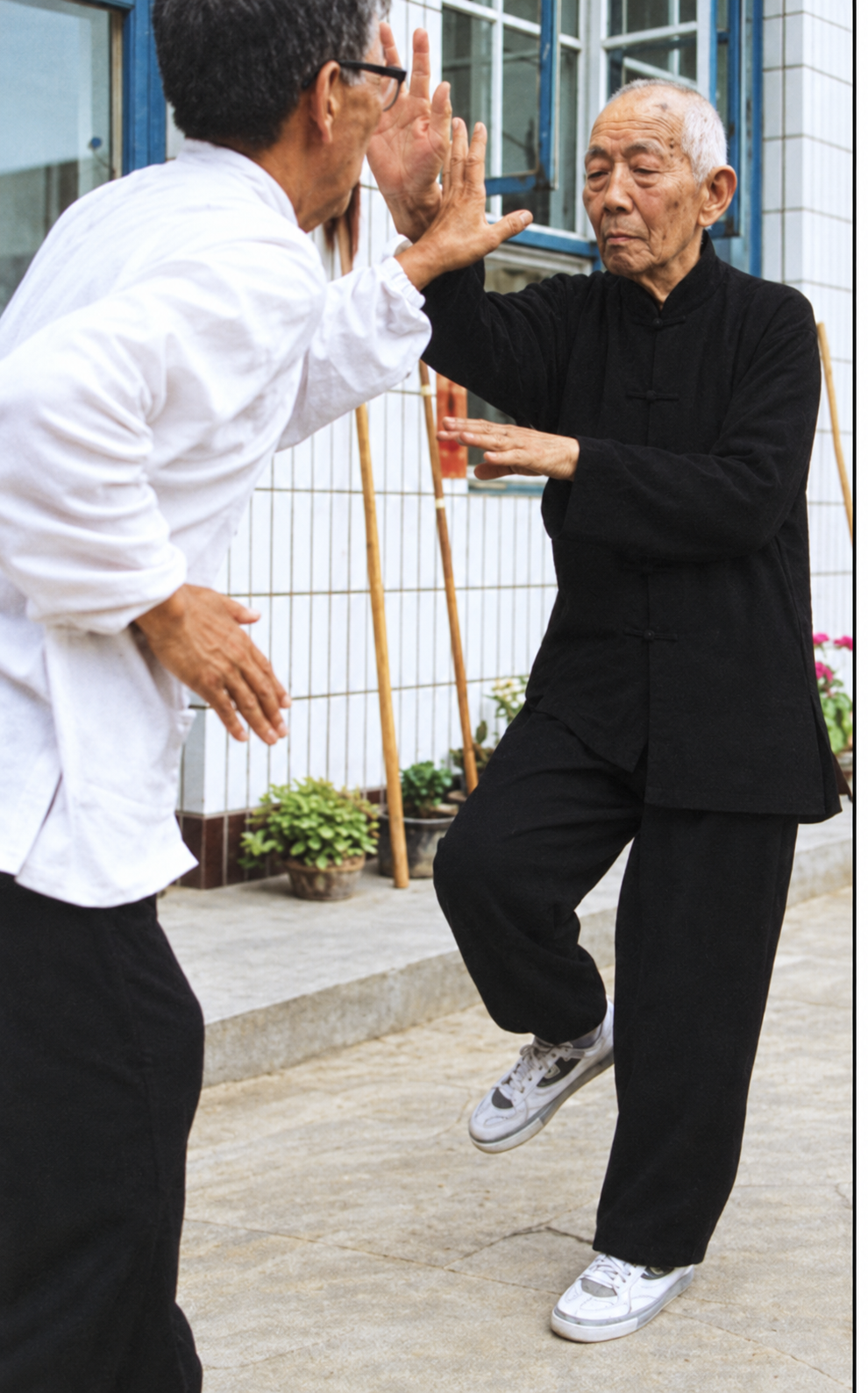
Wu Dianke practicing with his student (digitally restored and colourised)
Commentary: Reading the Origins Critically
A Critical Argument with Uneven Foundations
Wu Dianke and Wu Lianru’s article is valuable as an example of practitioners questioning inherited founding stories. Its authors ask why a method supposedly taught to Yue Fei’s officers disappeared from the record, why a celebrated general’s grandson did not mention it, and why the art’s transmission depends on a manuscript rediscovered centuries later. These are useful questions.
However, we cannot automatically establish the authenticity of the texts used to reconstruct Ji Jike’s life. The article treats the so-called Personal Account as a source from which a plausible history can be recovered by setting aside its more fantastic details. Before doing so, we need to establish when the account first appears, how its surviving copies relate to one another, and what supports its attribution to Ji. A first-person voice and an old date written at the end of a text do not authenticate its authorship.
This distinction also applies to the preface attributed to Dai Longbang. In his contributed essay in Dragon Body, Tiger Spirit, Jarek Szymanski examines chronological difficulties in the conventional Ji Jike–Cao Jiwu–Dai Longbang transmission and challenges the reliability of that preface. His discussion also introduces early Six Harmonies writings associated with Wang Zicheng and a teacher surnamed Zheng, providing a different basis for investigating the transmission.
Yue Fei: Historical Founder and Symbolic Ancestor
In my biography of Yue Fei, I discuss both the lack of convincing support for his creation of Xingyi’s ancestral art and the reasons why his name became attached to it. His historical reputation offered later practitioners an exemplar of loyalty, courage and commitment. In the political setting of the Ming–Qing transition, that association could carry particular meaning. [B]
Wu and Wu propose a related explanation: Ji may have attributed his own achievement to Yue Fei because of his loyalty to the fallen Ming and the difficulties of establishing a new art. As I explain in my book, Yue Fei can continue to function as a spiritual exemplar without our accepting him as the literal author of the art or its classical texts. The same distinction appears in my introduction to the Nine Essential Requirements Treatise: its importance within Xingyi traditions does not depend on demonstrating that Yue Fei wrote it. [B, C]
From Spear Methods to Civilian Boxing
One of the most significant ideas in the article is the question attributed to Ji: how should someone defend himself during peace, when going about with a spear is no longer appropriate?
A related passage appears in Dragon Body, Tiger Spirit in the introduction to the Key Extracts of the Ten Methods. In my commentary there, I discuss the development of civilian barehand practices from military methods and weapon skills. This helps distinguish a system intended for personal protection in daily life from an army’s methods of fighting with weapons. [D]
This distinction is particularly relevant to a claim frequently encountered in contemporary Chinese martial arts discussions: that the predominantly barehand systems we practise today were “battlefield arts”, used in that form in the military conflicts of ancient China. Applied to arts such as Xingyi Quan, this conflates an association with military skills or personnel with evidence that their unarmed methods constituted a system of battlefield warfare.
Chinese armies possessed sophisticated weapons, armour, formations and tactics. On such a battlefield, choosing to rely on punches and kicks against armed opponents would surrender the advantages of reach, protection and collective organisation that military equipment and training were designed to provide. A barehand method’s effectiveness in civilian self-defence does not establish its suitability as a primary means of fighting soldiers equipped for war.
The distinction was recognised within military literature itself: in the boxing chapter of his Jixiao Xinshu, Ming Dynasty General Qi Jiguang describes boxing as apparently having little bearing on large-scale battle, while valuing it for developing movement and preparing beginners for further martial training.
The statement attributed to Ji reinforces this distinction. Its logic is that weapons provide protection during armed conflict, whereas a different solution is needed for personal protection in peaceful daily life. Within the narrative, barehand boxing answers that civilian need. It does not describe soldiers abandoning their spears to fight battles with their fists.
Ji’s remembered expertise with the spear therefore gives the proposed development of boxing from weapon methods a meaningful place within the tradition.
Shaolin and the Direction of Transmission
The article’s most definite historical claim concerns Shaolin: Ji studied there, and his later art developed from what he had learned. Other accounts instead describe him transmitting his methods to the monks. My Ji Jike biography records versions of these traditions with their uncertainties. [E]
The authors’ proposed sequence from the Five Animal Frolics to Shaolin’s Five Forms and then Xinyi’s Ten Forms does not, by itself, demonstrate a line of transmission. Earlier use of animal imagery and later use of animal imagery can suggest a comparison, but chronology and resemblance alone do not establish who taught whom or which practice directly produced another.
The same caution applies to the two versions of the Ten Methods. Close textual correspondence can indicate a shared textual history. Establishing that one Shaolin-labelled version was the original, and that an attributed Cao Jiwu version was its later commentary, requires evidence about the age and transmission of the copies. Their titles alone cannot settle the direction of borrowing.
In my overview of the Ten Methods, I question its attribution to Cao Jiwu and consider the possibility that its contents reflect a body of teaching accumulated through successive generations. My commentary on the introduction also draws attention to Master Zheng, a figure whose presence complicates a simple direct transmission from Ji to Cao. [D] These issues remain relevant even if we accept the broader conclusion that Ji played a foundational role.
The discussion of “internal” and “external” likewise preserves a particular explanation of these labels in terms of secular and monastic affiliations. It is useful to record that explanation as part of the literature, while recognising that the quoted texts and their terminology also require historical evaluation.
Ji Jike, Xinyi and the Later Development of Xingyi
The article begins by distinguishing Xingyi Quan from its predecessor, Xinyi Quan, but concludes by calling Ji Jike the founder of Xingyi Quan. That final wording compresses several stages of development.
In my biographies of Ji Jike and Li Luoneng, I distinguish Ji’s position as the generally recognised progenitor of the ancestral art from Li’s later reorganisation and development of Xingyi Quan. Jarek’s historical essay similarly traces a family of related arts rather than an unchanged system handed down intact from one individual. [A, E, F]
For this reason, I would describe Ji as the foundational figure in the ancestral tradition from which Xingyi developed. This leaves room to recognise the subsequent contributions of Henan Xinyi practitioners, the Dai family, Li Luoneng and the generations who refined the art into its differing branches.
Wu Dianke and Wu Lianru’s article deserves to be read both for the questions it raises and for the assumptions it preserves. Publishing it in translation makes those arguments available for comparison with other sources. As with the disputed Guo Yunshen photograph, careful attention to attribution, chronology and the limits of our evidence allows us to appreciate the tradition without requiring every inherited account to serve as established history.
Further Reading and Practice
I examine these historical questions alongside the practical and theoretical writings of the art in Dragon Body, Tiger Spirit – A Translation and Explanation of the Classic Texts of Xingyi Quan. The book includes translations, extensive commentary, notes and biographies, together with Jarek Szymanski’s contributed historical essay. It is available through the Mu Shin Martial Culture online store.
For structured practical study, the Hua Jin Online Learning Program offers detailed instruction in Xingyi Quan and Liang-style Bagua Zhang, including foundations, forms, skill development, applications and weaponry.
References to Dragon Body, Tiger Spirit
All page references below refer to the printed pagination of the book.
[A] Jarek Szymanski, “Xingyi Quan – A Story of a History”, pp. xxiii–xxxiii; particularly pp. xxiii–xxix for the founding stories, early writings and disputed transmission.
[B] Byron Jacobs, “Yue Fei”, pp. 264–267; particularly pp. 266–267 for the founding attribution and its cultural and political interpretation.
[C] Byron Jacobs, overview of “Yue Fei’s Nine Essential Requirements Treatise”, p. 88.
[D] Byron Jacobs, “Cao Jiwu’s Key Extracts of the Ten Methods”: overview, p. 124; translated introduction, pp. 125–127; commentary, pp. 127–129. See also “Cao Jiwu”, pp. 271–273.
[E] Byron Jacobs, “Ji Jike”, pp. 268–270.
[F] Byron Jacobs, “Dai Longbang”, pp. 276–277, and “Li Luoneng / Li Feiyu”, pp. 278–279.
Related Article
Byron Jacobs, “The Mystery of the Photograph of Guo Yunshen”, including a translation of Jia Chi’s article and accompanying introductory and closing commentary.
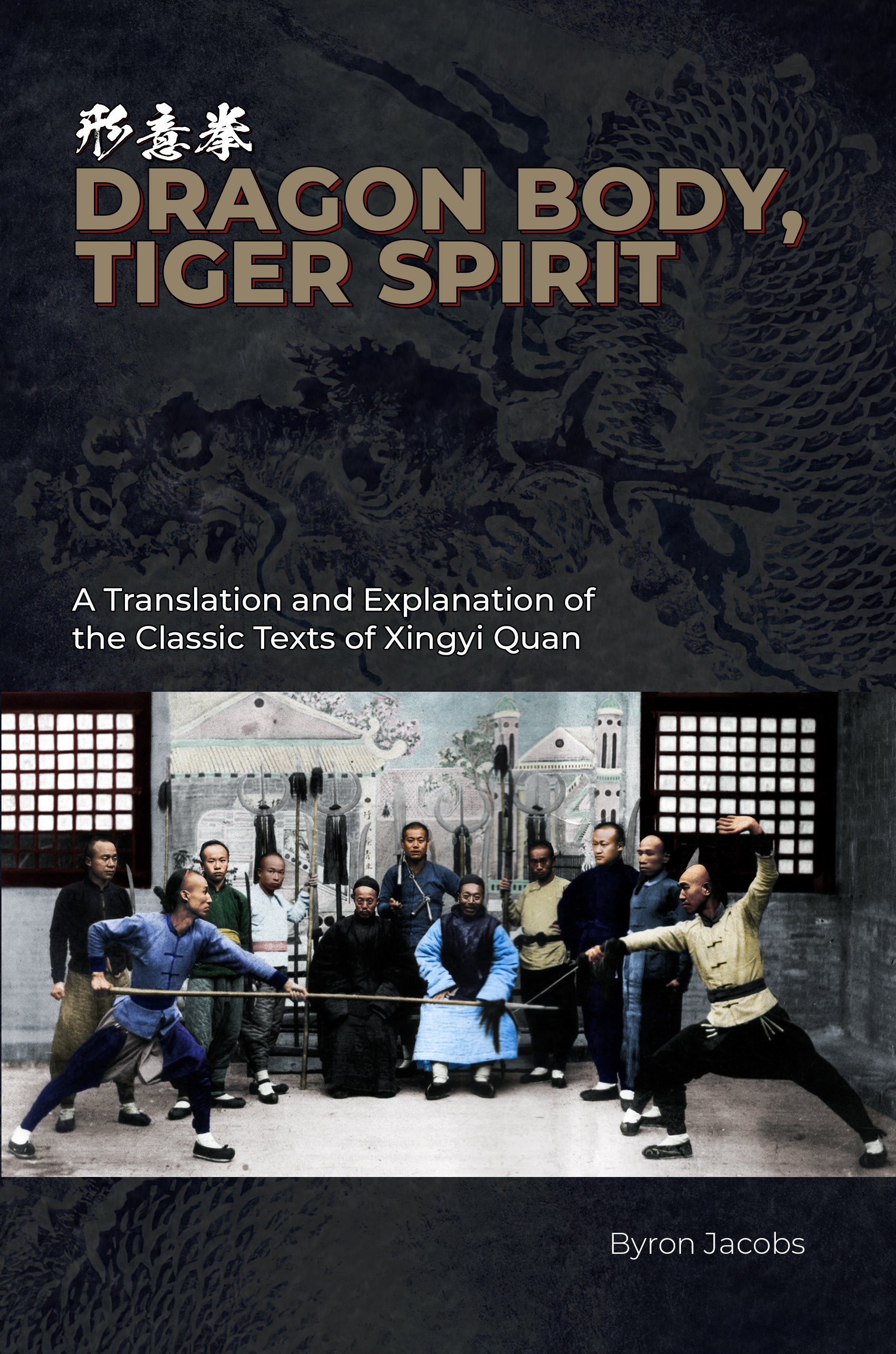
Dragon Body, Tiger Spirit is a detailed study of the classical texts of Xingyi Quan, combining careful translation with technical analysis, historical context and extensive commentary.
The classical writings preserve the principles, terminology and training methods transmitted by earlier generations of Xingyi Quan masters. In this volume, author Byron Jacobs examines these texts in relation to the practical study of the art, helping readers understand how their ideas apply to physical training rather than treating them solely as historical documents.
The book represents more than a decade of research and writing, supported by the author’s many years of martial practice and study under Master Di Guoyong. It brings together translated source material, explanatory notes, practical guidance, biographies, footnotes and reference information in one comprehensive volume.
Written for serious practitioners, teachers and researchers, the book may be studied from beginning to end or consulted repeatedly as a reference alongside regular Xingyi Quan training.
This volume includes
Translations of important classical Xingyi Quan texts
Detailed explanations of technical principles and terminology
Commentary connecting written theory with physical practice
Historical background and biographical material
Practical training guidance
Extensive footnotes and supporting references
Paperback edition
This edition contains the complete 388-page work in a lighter, flexible paperback format. Its reduced weight and compact dimensions make it convenient for regular study, travel and use alongside training.
Book details
Author: Byron Jacobs
Language: English
Paperback: 388 pages
Interior: Black and white
Dimensions: 156 × 234 × 20 mm
Weight: approximately 580 g
ISBN: 978-9925-8003-0-8
Publication date: 16 June 2023
Shipping and combined orders
If your delivery destination is not available at checkout, please contact us directly. Expedited delivery options such as FedEx may also be arranged on request.
For orders containing multiple books, contact us before purchasing so that we can confirm the most suitable combined shipping rate.