Clumsy Yet Agile: The Bear in Dai Family Xinyi and Hebei Xingyi Quan
The Bear Form/Shape in Dai Family Xinyi and Hebei Xingyi Quan
The bear occupies an important place in both Dai family Xinyi and Hebei Xingyi Quan. Its outward appearance suggests heaviness and clumsiness, yet the qualities sought in training include coordinated power, agility, stability, and decisive action. Looking at how each tradition describes the bear helps us understand what the animal shape is intended to cultivate.
Below is my full translation of Dong Liyi’s article on Dai Family Xinyi Bear Form Boxing, followed by selected passages from the Bear Shape section of my book, Dragon Body, Tiger Spirit. These passages include Di Guoyong’s poem and my commentary, together with Xue Dian’s discourse and my explanation of its theory. Read alongside the Dai family article, they reveal closely related ideas about contraction and expansion, rising and falling, and the relationship between outward bearing and inward intent.
The article written by Dong Liyi was an excerpt from a 1980’s or early 1990’s Chinese martial arts magazine wihin my teachers collection. I kept the clipping but unfortunately do not recall which issue or which magazine I clipped it from.
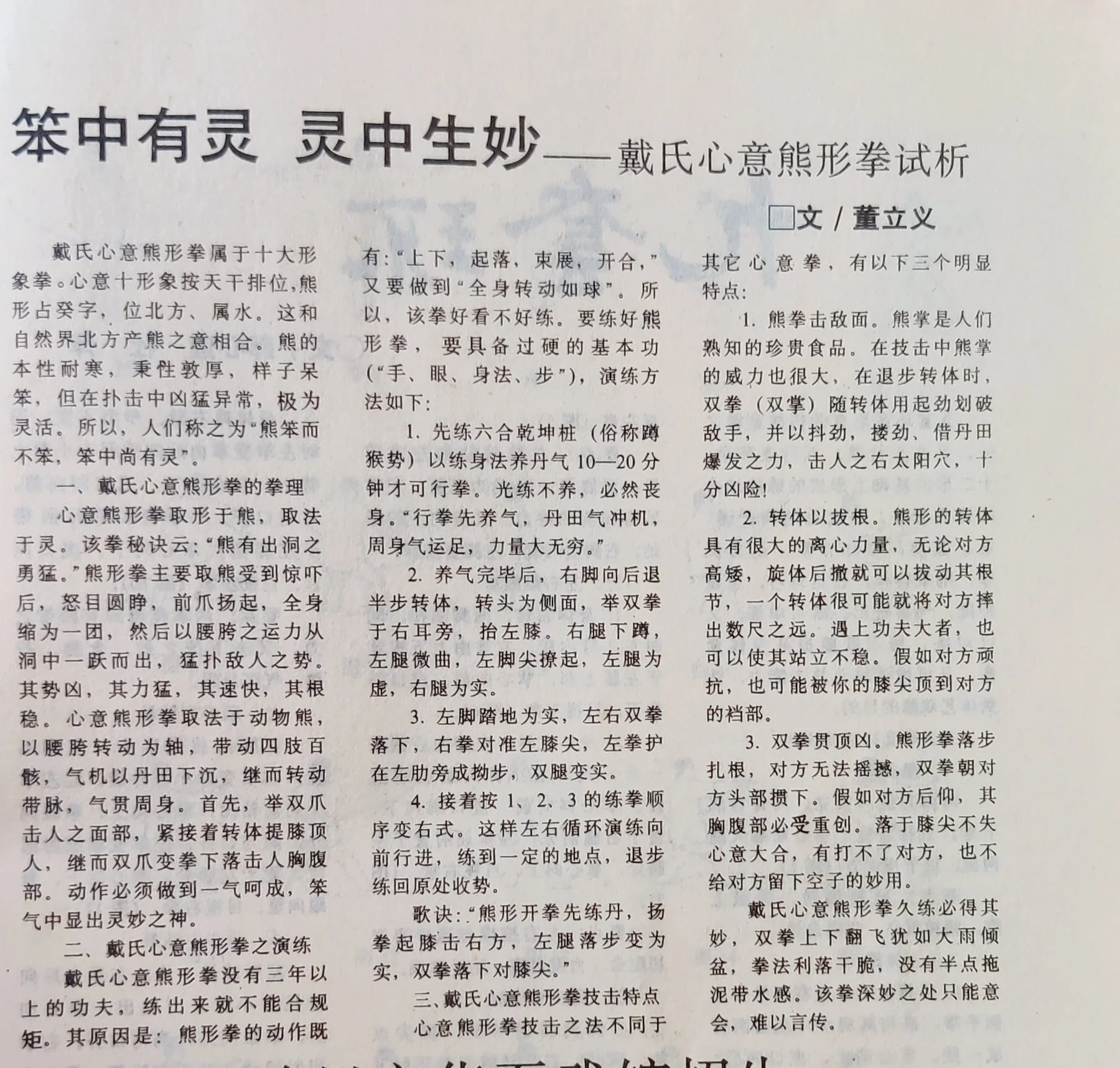
The original article
AGILITY WITHIN CLUMSINESS - SUBTLETY BORN OF AGILITY
An Analysis of Bear Form Boxing in Dai Family Xinyi
By Dong Liyi
Bear Form Boxing in Dai Family Xinyi1 belongs to the Ten Animal Forms. The ten animal forms of Xinyi are arranged according to the Heavenly Stems (天干 — tiāngān). The Bear Form corresponds to Gui, the north, and water. This accords with the association of bears with the northern regions of the natural world.
Bears withstand the cold and have a solid, placid disposition. Although they appear slow and clumsy, they are exceptionally fierce and remarkably agile when pouncing and striking. Thus, people describe them as “clumsy, yet not truly clumsy; within their clumsiness, agility remains.”
1 - The principles of Bear Form in Dai Family Xinyi
Xinyi Bear Form takes its outward form from the bear and its method from the bear’s agility. A secret boxing maxim states: “The bear possesses the ferocity of bursting out of its cave.”
Bear Form primarily draws upon the bear’s response when startled: its eyes widen in anger, its forepaws rise, and its entire body contracts into a ball. It then uses the power generated through its waist and hips to spring out of the cave and fiercely pounce upon its enemy. Its momentum is fierce, its power formidable, its speed swift, and its root stable.
Xinyi Bear Form models itself upon the animal. The rotation of the waist and hips serves as the axis, driving the four limbs and the whole body. The movement of Qi (energy) begins by sinking into the dantian (丹田 — dāntián), then turns through the belt vessel (带脉 — dàimài), allowing Qi (energy) to permeate the entire body.
First, raise both claws to strike the opponent’s face. Immediately turn the body and lift the knee to nail it into the opponent. Then change both claws into fists and strike downward at the opponent’s chest and abdomen. These movements must flow together in one continuous action, revealing a spirit of subtle agility within an outwardly clumsy bearing.
2 - Practising Bear Form in Dai Family Xinyi
Without at least three years of training, a practitioner cannot perform Dai Family Xinyi Bear Form in accordance with its requirements. This is because its movements incorporate “up and down, rising and falling, contracting and expanding, opening and closing,” while also requiring that “the whole body turn like a ball.”
Consequently, this form method is pleasing to watch but difficult to practise. To train Bear Form well, one must possess solid fundamental skills: hands, eyes, body work, and footwork. The practice method is as follows:
1. First practise the Six Harmonies Heaven-and-Earth Post-Standing Posture (六合乾坤桩 — liù hé qián kūn zhuāng), commonly called the Squatting Monkey Posture (蹲猴势 — dūn hóu shì), to train the body method/work and cultivate dantian Qi (energy). Practise for 10–20 minutes before beginning the form movements. Training without cultivation will inevitably harm the body. As the saying goes:
Before practising boxing, first cultivate qi;
In the dantian lies qi’s subtle mechanism.
When qi circulates fully throughout the body,
Strength becomes boundless.
2. After completing the cultivation of qi, step the right foot back half a step and turn the body. Turn the head to face sideways, raise both fists beside the right ear, and lift the left knee. Lower the body by bending the right leg, keep the left leg slightly bent, and lift the toes of the left foot. The left leg is empty, while the right leg is full.
3. Place the left foot firmly on the ground, making it full, and lower both fists. Align the right fist with the point of the left knee36, while the left fist guards beside the left ribs, forming a opposite stance. Both legs become full.
4. Following the sequence in steps 1, 2, and 3, change to the right-sided version. Continue advancing through alternating repetitions on the left and right. Upon reaching a chosen point, practise stepping backward until you return to the starting position, then conclude the sequence.
The boxing verse states:
To begin Bear Form, first cultivate the dantian;
Raise the fists and lift the knee to strike to the right.
The left leg steps down and becomes full;
Both fists descend, aligned with the point of the knee.
3 - The combat characteristics of Bear Form in Dai Family Xinyi
The combat methods of Xinyi Bear Form differ from those of the other Xinyi forms. They have three prominent characteristics:
1. The bear’s fists strike the opponent’s face. Bear paws are widely known as a prized delicacy. In combat, the bear palm also possesses considerable power. When stepping back and turning the body, both fists, or both palms, follow the rotation, using rising force to sweep through the opponent’s hands. Shaking force and gathering force, combined with the explosive power of the dantian, are then used to strike the opponent’s right temple. This is an extremely dangerous technique.
2. Turning the body uproots the opponent. The body rotation of Bear Form generates considerable centrifugal force. Whether the opponent is tall or short, rotating and withdrawing the body can dislodge their root. A single turn may throw the opponent several feet away. Even against someone with considerable skill, it can destabilise their stance. If the opponent stubbornly resists, the point of your knee may also drive into their groin.
3. Both fists drive fiercely down upon the head. In Bear Form, stepping down (placing the foot down) establishes a firm root that the opponent cannot shake, while both fists strike downward toward their head. If the opponent leans backward, their chest and abdomen will suffer a heavy blow. Bringing the fists down toward the point of the knee preserves the great union of heart and intent (emotion and intent). This also has the subtle advantage that, even if you fail to strike the opponent, you leave them no opening to exploit.
Through prolonged practice of Dai Family Xinyi Bear Form, one will inevitably acquire its subtlety. Both fists fly up and down like a torrential downpour. The boxing methods are clean and decisive, without the slightest sluggishness or hesitation. The profound subtleties of this method can only be grasped through personal understanding; they are difficult to convey in words.
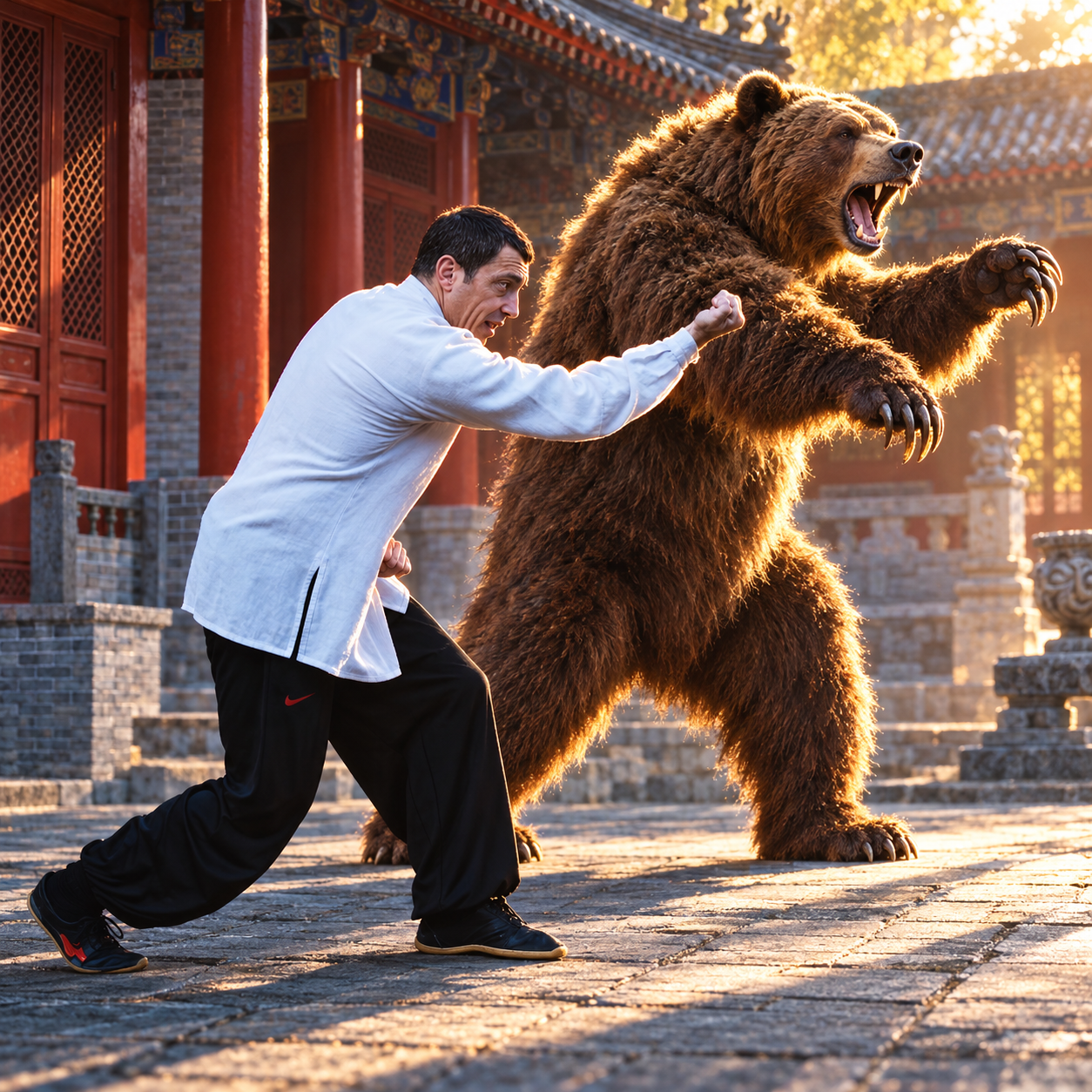
Dai Family Bear Shape Demonstration
Connections with the Bear Shape in Hebei Xingyi Quan as discussed in “Dragon Body, Tiger Spirit”
Outward calm and inward force
Dong Liyi’s opening description immediately brings to mind Xue Dian’s account of the Bear Shape. In my translation of Xue Dian’s discourse, he writes:
“The bear is the dullest and most obtuse of all the animals; it has an unyielding nature, and is physically the most powerful. This shape is the mightiest, yet externally it is Yīn while internally being Yáng.”
Both texts begin with the bear’s seemingly clumsy disposition and connect it to formidable power. Dong Liyi emphasises agility concealed within that appearance. Xue Dian describes an outwardly quiet bearing with an active, imposing quality within.
In my commentary on Xue Dian’s discourse, I explain that the bear’s actions “are not rushed, flustered or excessively forced, they seem almost passive.” Its internal spirit and intent, however, remain active and unyielding. This gives a useful way of reading Dong Liyi’s phrase “within their clumsiness, agility remains.” The outward appearance need not reveal the readiness or quality of the movement underneath it.
For practice, the connection is significant: the bear’s heaviness should not be confused with stiffness, nor its calm bearing with hesitation. Its strength must remain available for coordinated action.
Contraction and expansion and the interchange of rising and falling
One of the clearest theoretical connections is Dong Liyi’s requirement to express “up and down, rising and falling, contracting and expanding, opening and closing.” These qualities also occupy a central place in the Bear Shape material in my book.
Xue Dian discusses the combined practice of the eagle and bear:
“When combined with the eagle shape, when the energy (Qì) is rising it is Yáng, and when the energy sinks it is Yīn.”
He goes on to describe their interchange as the eagle and bear fighting, explaining its overall meaning as the united energy of expansion and contraction. In my commentary, I develop the point:
“Indeed, it is the unity of Yīn and Yáng that is the key point. The unity of contraction and expansion, of rising and falling, of bending and extending, coiling and uncoiling, storing and releasing, closing and opening, etc. from which everything emerges.”
This helps clarify the significance of Dong Liyi’s account. His description of the bear contracting into a ball and then springing outward gives a concrete expression of gathering and releasing. His training sequence also passes through changes of height, weight, and direction. The opposites belong to a connected process, with one action preparing and supporting the next.
In the Hebei Xingyi Quan material, the eagle and bear pairing makes this relationship especially explicit. The bear’s prominent rising and drilling action is paired with the eagle’s overturning and falling action. The two descriptions express related principles through their respective practices.
Reading Dong Liyi’s article beside the Bear Shape material in Dragon Body, Tiger Spirit draws attention to a recurring set of principles. The bear combines an outwardly quiet bearing with a forceful inward disposition. It gathers and releases, changes between rising and falling, and coordinates its movements through the body.
The Dai family description gives particular attention to the waist and hips, rotation, rooting, and the transition from gathering to striking. The Hebei Xingyi Quan passages bring the neck and shoulders, decisive forward entry, and the eagle and bear relationship into sharper focus. Together, they offer complementary perspectives on what the bear is intended to develop.
For practitioners, this makes the animal imagery worth examining closely. The bear’s apparent clumsiness carries a lesson about how power may be concealed within a calm bearing. Understanding its shape means studying the coordination, changes, and intent that give the outward movements their purpose.
Hebei Xingyi Quan Bear Shape
For a deeper exploration of Xingyi Quan’s classical theory, animal shapes, and training principles, my book, Dragon Body, Tiger Spirit, is available to purchase directly from the Mu Shin Martial Culture webstore or through Amazon. You can also learn the Twelve Animal Forms, including the Bear Shape, through detailed lessons in the Hua Jin Online Learning Program, bringing these principles into your own practice wherever you are in the world.
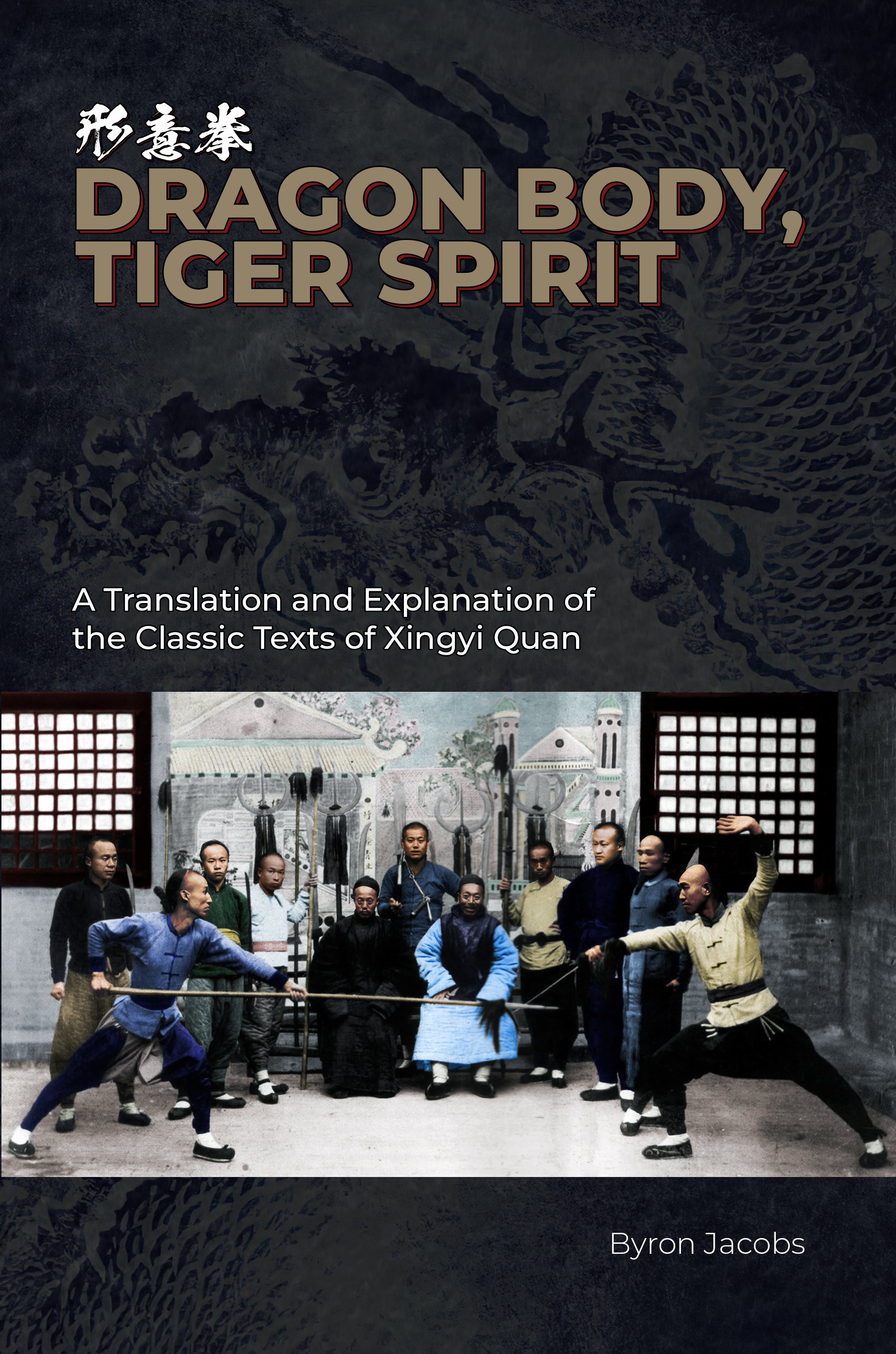
Dragon Body, Tiger Spirit encapsulates a careful presentation, translation and extensive commentary of the classical texts of Xingyi Quan. These texts aimed to document and preserve the principles and techniques at the very heart of this traditional Chinese martial art. Dragon Body, Tiger Spirit is an invaluable resource for martial arts practitioners looking to gain insight into the essence of authentic, traditional Xingyi Quan as codified and handed down from one generation to the next by previous masters of the art.
This carefully researched and written reference reflects a decade of painstaking work, backed up by decades of dedicated martial practice by the author Byron Jacobs, a disciple of Master Di Guoyong. Within the pages of this book, readers will find a wealth of practical advice, analysis, commentary, footnotes, biographies and reference material that will help orient their practice of Xingyi Quan in a manner that helps them stay true to its essence. Serious practitioners of the martial arts will find themselves gaining new insights into their practice each time they revisit this expanded analysis of the classical texts and a deeper appreciation of the historical underpinnings of the art.
Dragon Body, Tiger Spirit will remain an evergreen reference text for all Chinese martial arts enthusiasts for years to come.
NOTE:
Should your country of delivery not display at checkout, please do contact us directly to process your order.
Should you wish to use expedited delivery such as Fedex etc. please do contact us directly to process your order.
Should you want to order more than one copy of the book in a single order, contact us directly to confirm your shipping cost.