Before Guoshu: A 1923 Chinese Martial Arts Performance at Shanghai Town Hall - The North China Herald (3)
Introduction
Over the past while, I have been presenting and discussing old archival articles that I have found in both English and Chinese language newspapers and publications from the Republican era. These reports, notices, interviews, and commentaries offer us valuable glimpses into how Chinese martial arts were understood, promoted, performed, and discussed during one of the most important transitional periods in their modern history.
The following article is another fascinating example. Published in 1923, it reports on a Chinese martial arts performance held at the Town Hall in Shanghai, featuring Chinese boxers and wrestlers from across the country. The article is especially interesting because it reflects how Chinese martial arts were being publicly presented at the time: not merely as local fighting traditions or theatrical curiosities, but as organized systems of physical culture, national strength, pride and public athletic display.
This article also connects directly with a previous piece I published concerning a similar martial arts demonstration held in 1922, once again arranged under the direction of Ma Liang. In that earlier article, the performers were described as soldiers who had been trained up through Ma Liang’s martial arts program. The 1923 performance appears to involve a broader group of civilian martial artists and wrestlers, suggesting a movement from Ma Liang’s initial efforts to introduce and standardize these practices within the military into a wider public sphere.
This is an important point. Ma Liang was not simply arranging martial arts shows. He was a critical figure in the Nationalist movement to promote Chinese martial arts during the Republican period. His work helped frame martial arts as a form of national physical education, cultural renewal, and collective strengthening. He was also crucial in the establishment of the Nanjing Central Kuoshu Institute, one of the most significant institutions in the modern history of Chinese martial arts. To understand the modernization of Chinese martial arts, even up to the present day, one must understand Ma Liang, his work, and his lasting effect on the way these arts were organized, promoted, and reimagined.
Another interesting link between the 1922 and 1923 accounts is the mention of a young boy and girl performing. In the earlier article, a young boy and girl were also highlighted as part of the demonstration, and it seems very likely that the children mentioned here were the same pair. Their presence is significant because it shows that these events were not only displays of fighting skill, but also staged demonstrations of transmission, discipline, physical education, and national vitality. Children performing martial arts in this context helped present the arts as something that could be taught, systematized, and passed on to future generations.
One of the most revealing points in the article is the statement that Chinese wrestling was the “parent” of jiu-jitsu. This was not just a casual observation by a foreign journalist. It reflects a broader nationalist rhetoric being promoted and hammered in during the period, particularly by figures such as Ma Liang and others involved in the Republican-era martial arts revival. Chinese wrestling, or Shuai Jiao, was being positioned as the older and more original source from which Japanese jiu-jitsu, and later judo, had supposedly developed.
This claim served several purposes. On one hand, it asserted Chinese cultural seniority at a time when Japan’s martial traditions were becoming increasingly visible and respected internationally. On the other, it helped obscure or reframe the actual Manchu and Mongol roots of much of Chinese wrestling, a topic I examined in detail in my Hidden History of Shuai Jiao YouTube series. Given Japan’s growing encroachment on China during the Republican era, such claims also carried an obvious political and emotional force. The martial arts were not only being practiced and demonstrated; they were being used in a larger conversation about nationhood, cultural pride, and resistance to foreign pressure.
This short newspaper report therefore gives us far more than a simple description of a night of entertainment at Shanghai Town Hall. It provides a small but important window into the transformation of Chinese martial arts in the Republican era: from military training to public performance, from local practice to national culture, from inherited fighting methods to modern physical education, and from practical skill to symbolic expression of Chinese identity.
I am currently preparing a full-length episode on Ma Liang, which will be released on YouTube in the coming months. His role in the development of modern Chinese martial arts is too important to be treated as a passing footnote. The more one studies this period, the clearer it becomes that Ma Liang’s influence was enormous, and that many later developments in the Guoshu movement and the public presentation of Chinese martial arts cannot be properly understood without examining his work.
The article below, titled “Chinese Athletes at Town Hall,” gives us a vivid English-language account of one such event in Shanghai in 1923. While the terminology and tone reflect the period in which it was written, the report remains an important glimpse into the early Republican-era promotion of Chinese martial arts and the public image they were beginning to acquire. Here I present it in full.
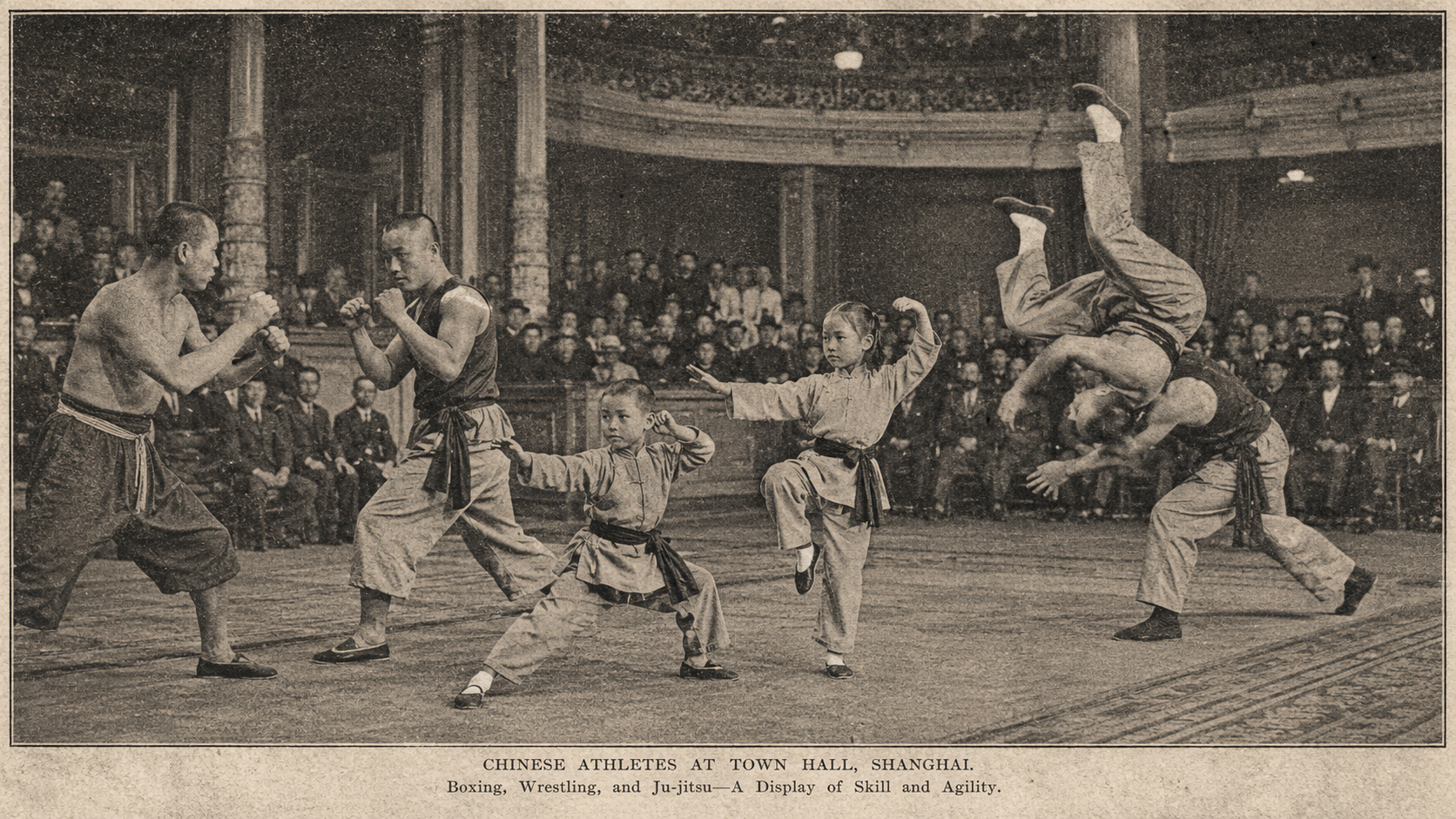
Re-created image (not from orignal publication)
CHINESE ATHLETES AT TOWN HALL
Ancestor of Jiu-Jitsu: Speed, Dexterity and Courage: A Remarkable Display
A fairly large audience gave an enthusiastic reception to 250 Chinese boxers and wrestlers at the Town Hall on Saturday evening, when athletes representing every province in China met and gave an exhibition of their skill in the manly art of self-defence. The exhibition was held under the auspices of General Ma Liang, and many of the athletes were the same who took part in the recent ancient athletic games held at the West gate. The proceeds from the sale of tickets were devoted to the Chekiang Relief Fund, and it was stated that quite a considerable sum was realized. Through the courtesy of General Ho Feng-ling the Arsenal Band furnished incidental music.
In addition to the individual displays of boxing and wrestling against an imaginary opponent, there were several good bouts in which the antagonists were real flesh and blood and took amazing and difficult falls apparently suffering not the slightest injury.
Chinese wrestling is in reality the parent of jiu-jitsu now taught universally in the Bushido wrestling schools in Japan. It is maintained that the men do not have to be of equal weight or strength, but the victor’s success depends mainly upon his agility in securing the primary hold upon his adversary. This contention was proved more than once on Saturday evening, when a wrestler frequently threw an opponent 20 or 30 pounds heavier. On the other hand, Mr. Ling Soh-ching, from Tientsin who weighed in the neighbourhood of 13 stone, threw seven opponents in nine minutes, which was considered the record for the evening. By way of explanation, it might be added that a “throw” according to the Chinese definition, means usually casting your adversary some 15 or 20 feet away so that he rolls on his back. Nor were there any mats or mattresses to break the force of the fall.
Several of the boxing bouts were fast and furious affairs. The rules laid down by the illustrious Marquis of Queensbury doubtless have not been published in Chinese, since the various competitors fought with bare knuckles, kicked, scratched, bit, clawed each other with reckless abandon, that is, they would have if the opportunity had offered. After “squaring off,” each contestant made a dash toward the other and kicked and struck continually, the object apparently being to blind your opponent before he had the opportunity of carrying out his evil designs on you. The dexterity with which kicks and blows were parried equally well was a marvel of speed and agility.
The honours of the evening, however, were unquestionably awarded to a little girl of 10 years and her brother a year and a half younger. Not only did these children imitate their elders to perfection, but in addition gave several quite remarkable exhibitions on their own behalf.
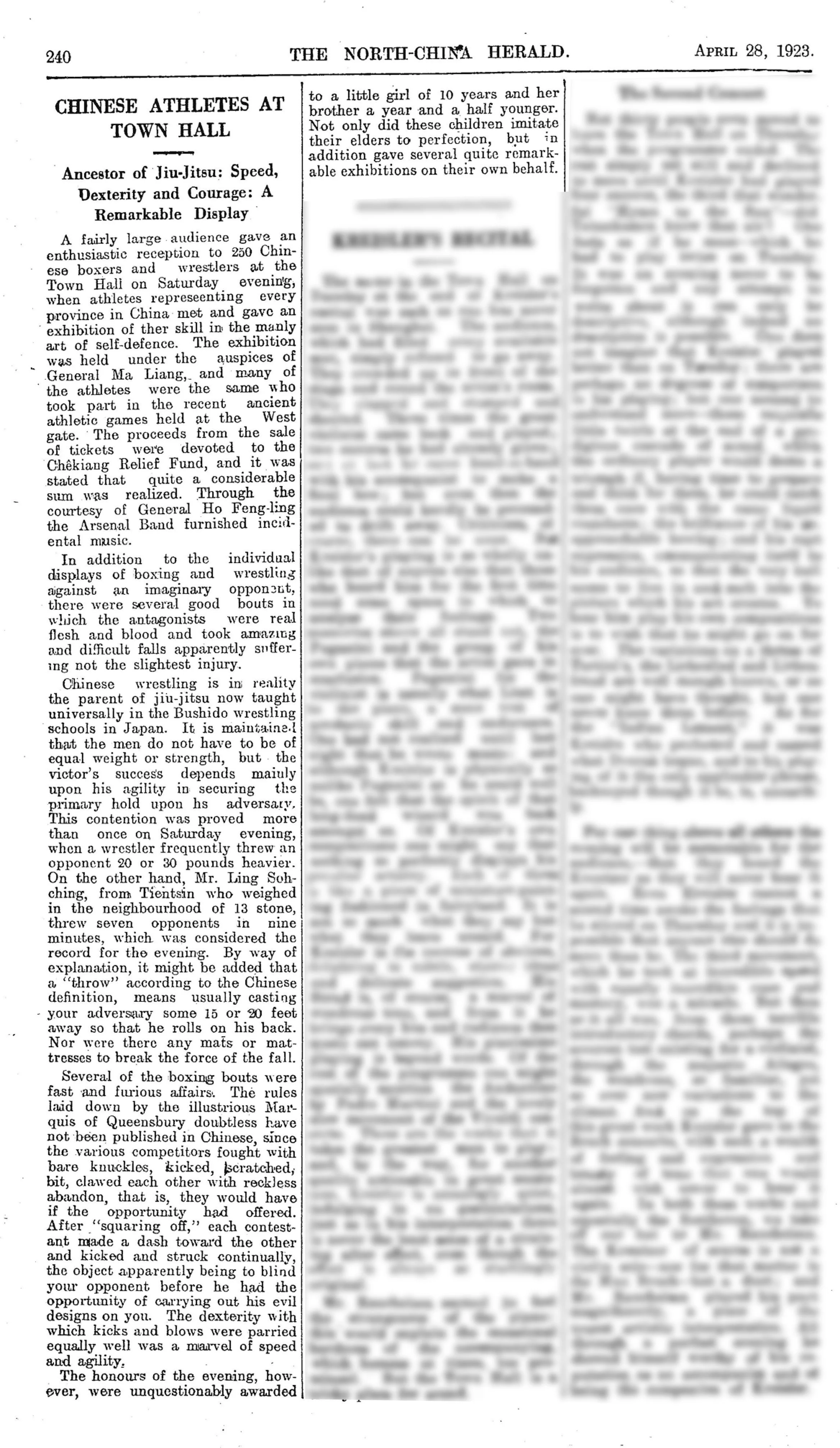
Original article (1)

Unlock the secrets of one of China’s most revered martial arts with Liang Style Bagua Zhang, Volume One. Written by renowned 4th-generation master Di Guoyong, this guide explores the foundational practices of Bagua Zhang—a martial art known for its circular movements, unique footwork, and profound internal principles.
This volume covers the origins of Bagua Zhang, the development of the Liang style, and the life of its founder Liang Zhenpu, while tracing the art’s evolution through successive generations. Di Guoyong also shares insights from his training under the legendary Li Ziming, offering a rare, firsthand view into the Liang lineage.
Essential techniques are explained clearly, building a solid base for both beginners and experienced practitioners. Key practices for mastering the Liang system are included, along with an in-depth study of the Eight Fixed Posture Palms. Instructions are supported by detailed illustrations and video references to help readers grasp each movement confidently.
Translated, co-authored, and edited by Byron Jacobs, a 5th-generation practitioner, this book delivers traditional knowledge in a modern, accessible format. Whether refining your skills, exploring Bagua’s roots, or deepening your martial understanding, this volume is an essential resource for serious Chinese martial arts practitioners.
The Liang Style Bagua Zhang series is your trusted companion on the path to mastery—offering clarity, structure, and inspiration every step of the way.
NOTE:
Should your country of delivery not display at checkout, please do contact us directly to process your order.
Should you wish to use expedited delivery such as Fedex etc. please do contact us directly to process your order.
Should you want to order more than one copy of the book in a single order, contact us directly to confirm your shipping cost.