Wang Ziping Shanghai Performance - The North China Herald (2) - “Chinese Wrestling & Boxing” 1922
Wang Ziping in 1922: A Rare Eyewitness Account from The North-China Herald
In the latest episode of Kung Fu Explained, I explored the legendary life and strength feats of Wang Ziping, one of the most celebrated martial artists of the Republican era. During that video, I briefly referenced a remarkable 1922 article from The North-China Herald describing a public exhibition led by Ma Liang and featuring Wang Tze-ping (Wang Ziping) in Shanghai.
The article offers something rare and invaluable: a contemporary, Western eyewitness account of Chinese wrestling, boxing, weapons work, and Wang Ziping’s astonishing demonstrations of strength, including the famous feat in which he supported nearly three-quarters of a ton in weight.
In the video, I quoted portions of this report to illustrate how Wang Ziping was perceived at the time, even being called “the native Sandow.” But historical documents deserve to be read in full.
So here, I am presenting the complete transcription of the original December 9, 1922 North-China Herald article, exactly as it appeared.
This firsthand account gives us a vivid window into early 20th-century Chinese martial culture , not as legend, not as later retelling, but as it was recorded in its own time.
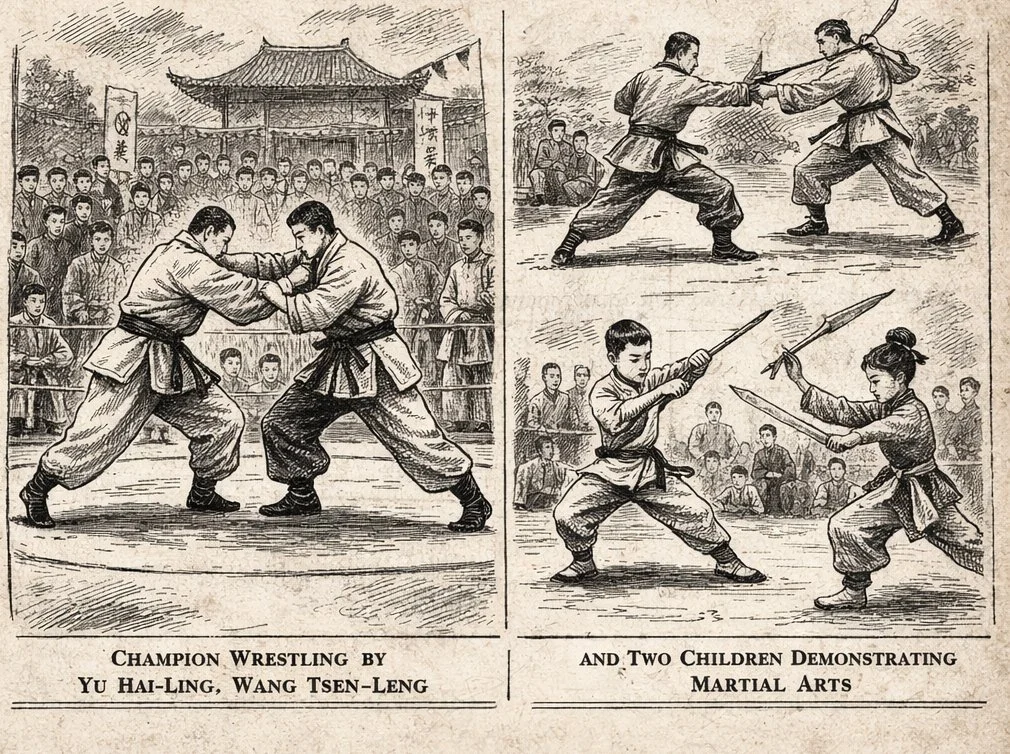
Re-created image (not from orignal publication)
CHINESE WRESTLING AND BOXING
Magnificent Exhibition in the Old Style by Ma Liang’s Experts at Nanyang
The best exhibition of Chinese boxing and wrestling and physical training that Shanghai has seen for many years took place at Nanyang College on Thursday afternoon. A great mass of visiting Chinese as well as the student body thronged the ringed arena, while scattered here and there was an occasional foreigner. The general standard of the performances was a very high calibre, old residents and district attesting the merit of the men.
Mr. Ma Liang, former governor of Shantung, and more recently resident of Tsingtao, had charge of the exhibition. Mr. Ma, now residing in Shanghai, is probably the most modern of Chinese leaders with reference to the benefits of physical training. It was through his personal efforts that the soldiery of Shantung attained their high standard of physical efficiency. Under the direction of Mr. Ma the company of 40 trained soldiers ran through the ritual of the boxing system. The entertainment was especially well received by the student body, who in their amateur way indulge in the same line of training these experts portrayed for them. The physique of this picked body of men was well above the average of the ordinary soldier, and though most of them were from Chihli and Shantung and therefore somewhat of larger stature than the local Chinese, their muscular development clearly demonstrated what can be done by the Oriental in the matter of health and strength.
PRODIGIOUS FEATS OF STRENGTH.
Probably the most interesting and noteworthy event of the afternoon was the act performed by Wang Tze-ping, generally known as Da lize, the Chinese champion strong man—the native Sandow. He manipulated an amateur dumbbell put together of two circular blocks of stone on a two inch wooden bar. This dumbbell of 180 pounds weight was hoisted easily, then spun in the air with one hand, the arm being fully raised. His second feature consisted in pressing up with two hands a bell of 250 pounds, whirling it and allowing it to settle on his shoulders, the head tucked between his arms on the chest, while the twirling motion upon his back and shoulders continued without assistance. The third and most spectacular event was a typical homely strong man stunt. Flat on his back, with feet extended in the air, he placed on them the big dumbbell, took into his raised arms the second bell, while a companion stretched himself over the trestles made of the two bells. Five men clambered on to the larger bar on the legs, and to the one making the bridge with his body was given still a third bell of 120 pounds weight. All this weight he supported until a child with flag was set above all. Allowing 840 pounds for the six men, 550 for the dumbbells and 50 for the child, the total mass sustained in the feat was 1,440 pounds, nearly three-quarters of a ton. A troupe of wrestlers, acting very similarly to foreign athletes, using a catch-as-catch-can grasp, but differing in that a fall consisted in being thrown to the ground in any position, came next on the programme. Yu Hai-ling and Wang Tsen-leng, champions of Chihli province, were among the favourites and disposed of their rivals with no difficulty.
The usual other features of a Chinese boxing class provided most of the afternoon’s sport. The method of defence in most cases was the San tzu chuen or as the name means, the three sticks; manoeuvre spear against spear, sword against sword, or spear against sword or any combination of various forms of swords, spears, daggers, and sticks was used. An unguarded man went barehanded against the swordsman and disarmed him, using the latter’s weapon to deal the deathstroke. The two-pronged spear, a yue yah chao, or literally the new moon fork, named by the resemblance to the queen of night, was cleverly handled against the broadsword, Da Tao.
Concluding the sport were two personal protégés of Mr. Ma Liang, children, a boy of seven and a girl of eight, who used miniature weapons of the same type as the older fellows, showing themselves to be worthy exponents of the science, by their fast jumping, long leaps, sinister darts and retreats, charges and ripostes and innumerable gymnastic gyrations.
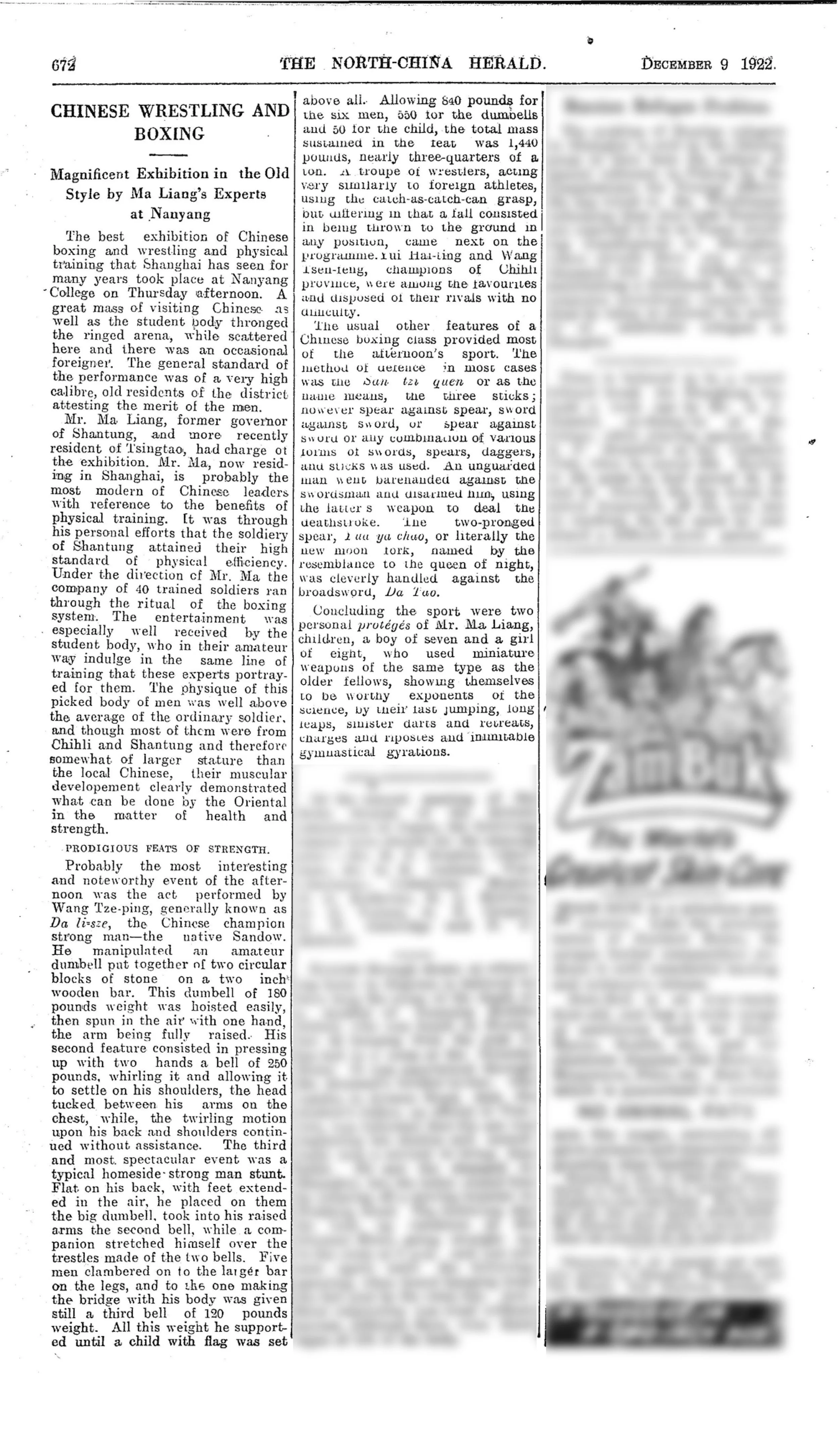
North China Herald - Original Article (9.12.1922)
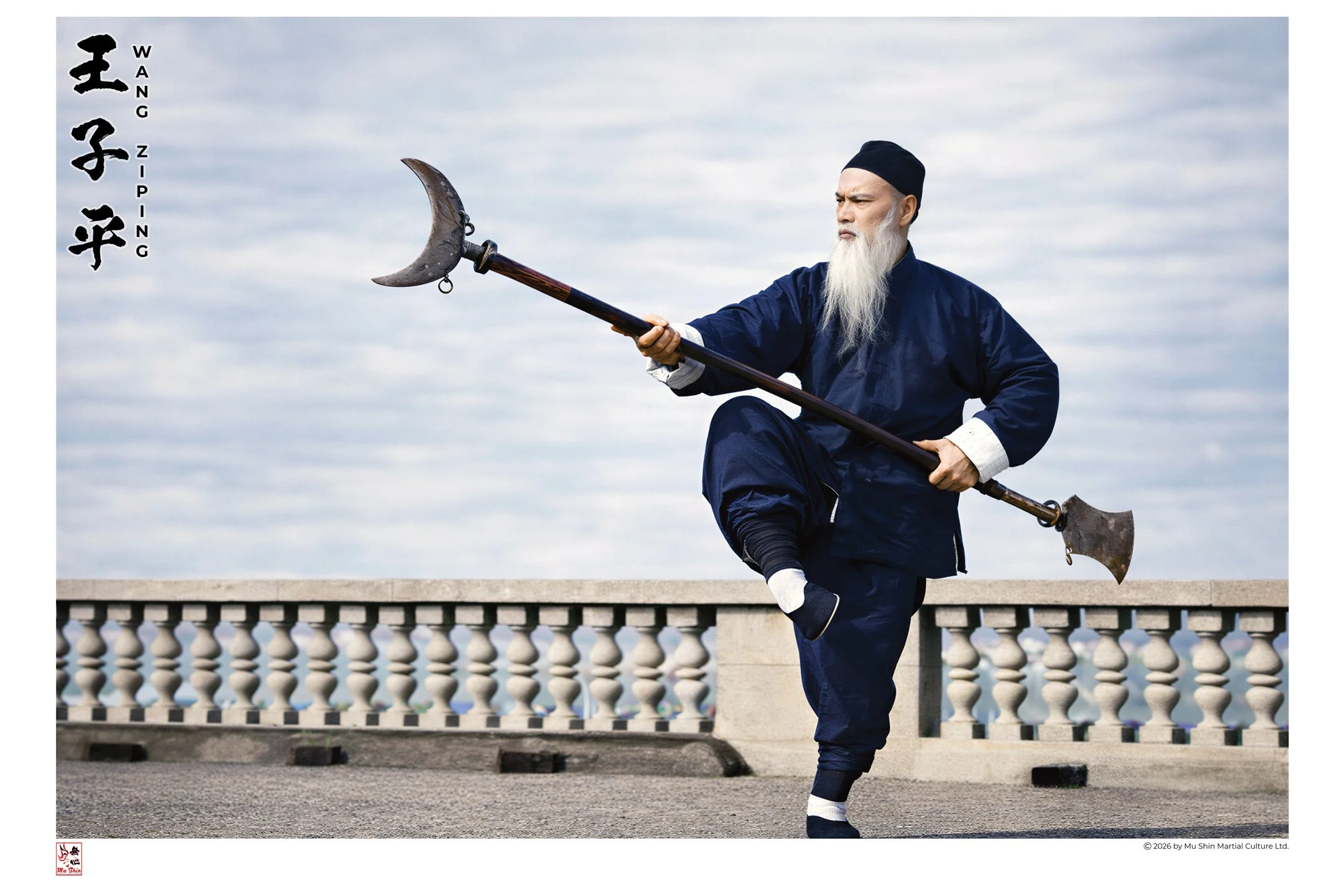
Strength. Discipline. Legacy.
Wang Ziping (1881–1973) stands as one of the most important martial artists of modern Chinese history. Born in Cangzhou into a renowned Hui Muslim martial family, he became known nationwide for his extraordinary feats of strength, refined skill, and unshakable moral character.
From early Republican-era strength exhibitions to leadership within the Central Guoshu Institute, Wang Ziping helped shape the modernization of Chinese martial arts at a pivotal moment in China’s history. His name became synonymous with discipline, resilience, and national renewal — a bridge between the world of the traditional jianghu and the emergence of modern Chinese physical culture.
This poster captures the presence and spirit of a man whose legacy extended across dynasties, political upheaval, and generations — carried forward by his family and students around the world.
Printed in high resolution with rich detail and historical depth, this piece is more than wall art.
It is a tribute to a martial artist who stood at the crossroads of legend and history.
NOTE:
Should your country of delivery not display at checkout, please do contact us directly to process your order.
Should you wish to use expedited delivery such as Fedex etc. please do contact us directly to process your order.
Should you want to order more than one poster in a single order, contact us directly to confirm your shipping cost.