Kung-Fu in the New York Times in 1947
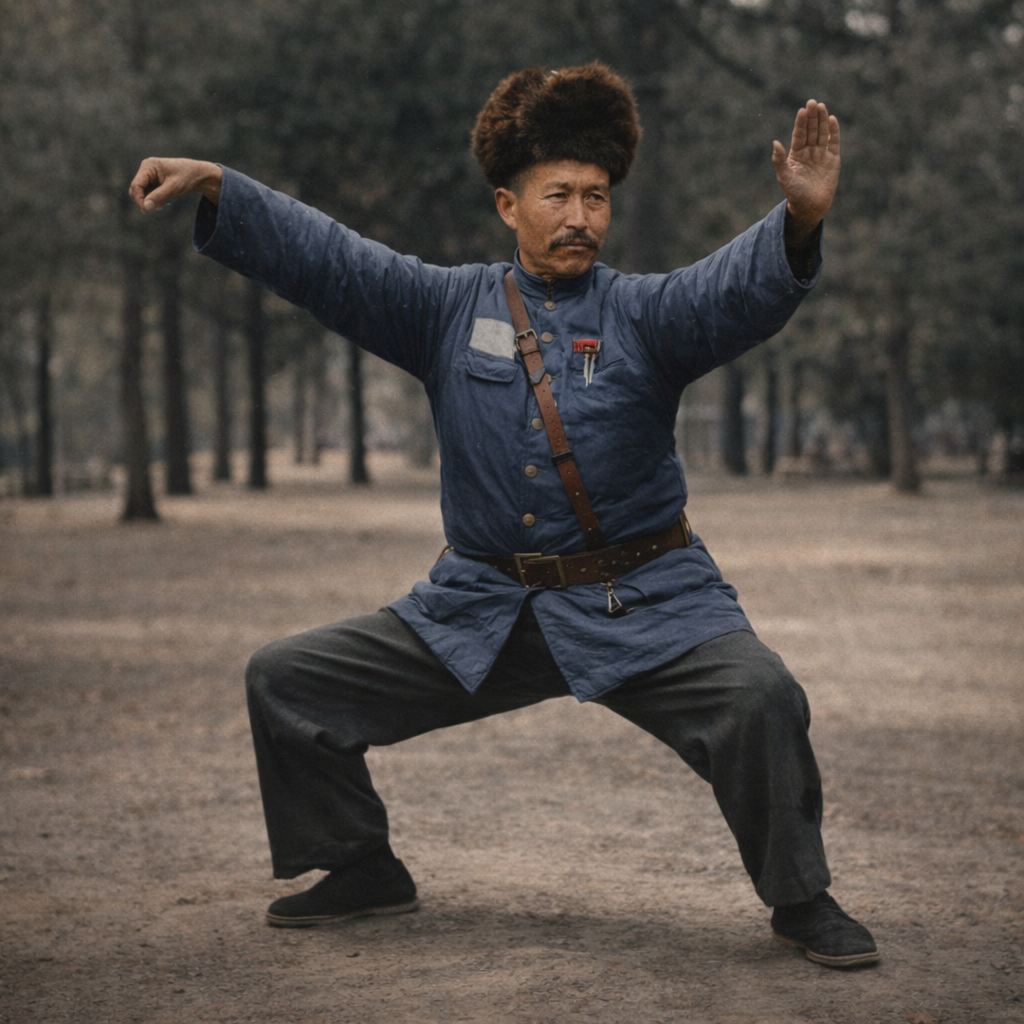
Zhang Zhijiang in a Taiji posture (digital recreation)
A Rare New York Times Glimpse into Republican-Era Kung-Fu (Guoshu)
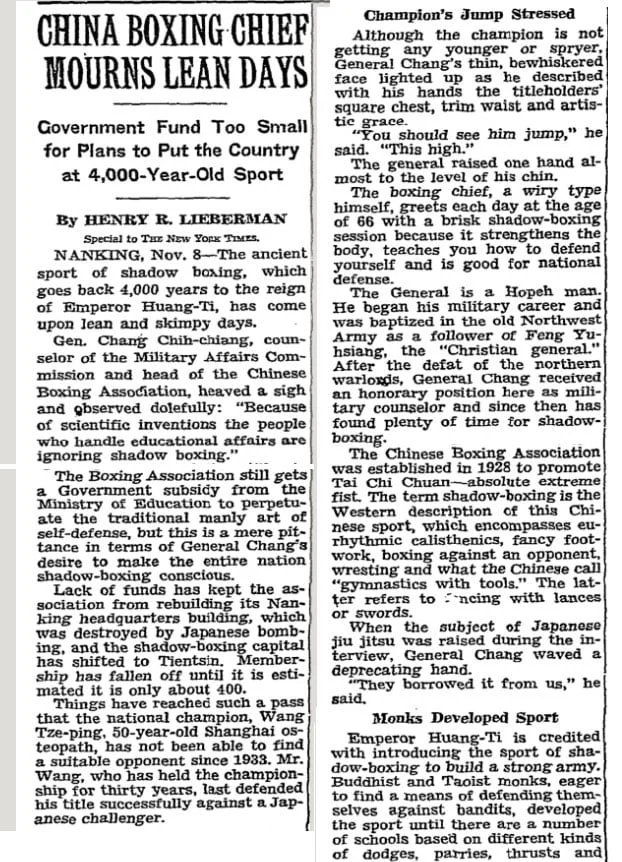
In my recent Kung Fu Explained episode on Wang Ziping, I briefly referenced a fascinating and rarely discussed historical document: a 1947 New York Times article titled “China Boxing Chief Mourns Lean Days.”
In this post, I’m making the full article available, along with some important context that helps us better understand what we’re actually looking at.
First, it’s important to clarify terminology. The article repeatedly uses the term “shadow boxing.” In this context, it is not referring to Taijiquan specifically, as many modern readers might assume. Rather, it is being used as a broad, Western catch-all term for Chinese martial arts training, particularly solo practice and forms. This becomes clear from the later description of the demonstrator, whose movement sounds far more consistent with Northern long-fist systems such as Cha Quan, rather than Taiji Quan. This distinction matters, as later English usage would narrow “shadow boxing” to refer specifically to Taijiquan, but that is not the case here.
Second, the article itself is remarkable simply for existing. A feature in a major western publication such as the NYT on Chinese martial arts, referred to at the time as Guoshu (國術), appearing in The New York Times in 1947 is extremely unique. This was a time when Chinese martial arts were being actively promoted as part of national identity and physical culture in China, but were still fairly unknown in the west.
The central figure in the article is General Chang Chi-chiang, better known as Zhang Zhijiang (張之江), a key figure in the modern development of Chinese martial arts. Zhang was the founding head of the Central Guoshu Institute in Nanjing, established in 1928 under the Nationalist government. His efforts were instrumental in transforming traditional martial practices into a modern standardized national system, tied closely to ideas of physical education, military preparedness, and national strength.
However, while the article is historically valuable, it must also be read critically.
It clearly reflects the narratives and biases of its time. Claims such as Chinese martial arts being “4,000 years old”,. being developed by monks or originating with the Yellow Emperor are not supported by historical evidence and represent longstanding cultural myths rather than documented factual history.
The article also carries a strong tone of Republican-era Chinese nationalism, which is not surprising given the political context. China had recently emerged from prolonged conflict with Japan, and this is reflected in the dismissive tone toward Japanese martial arts. One striking example is the claim that Japanese jiu-jitsu was “borrowed” from China. This statement is historically inaccurate. As discussed in my previous work on the history of Shuai Jiao, Japanese jiu-jitsu developed from indigenous combat traditions, likely influenced by local conditions and possibly ancient steppe-related grappling cultures. Ironically, Chinese Shuai Jiao itself which is often presented as an ancient Han tradition, was significantly derived from Manchu and Mongolian wrestling practices.
All of this makes the article particularly valuable, not as a straightforward historical account, but as a snapshot of how Chinese martial arts were being presented, interpreted, and politicized in the mid-20th century.
Below is the transcript of the article in full
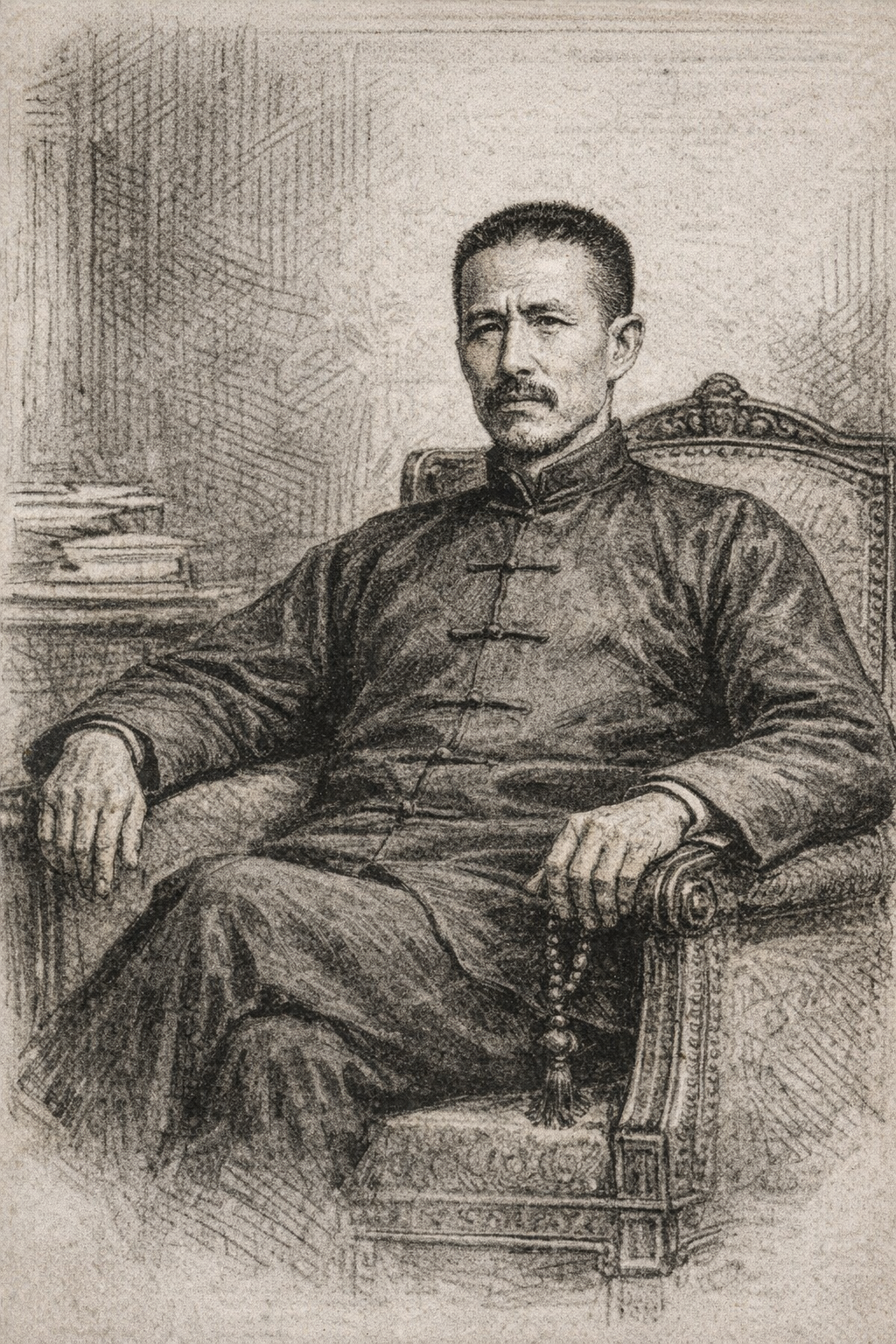
CHINA BOXING CHIEF MOURNS LEAN DAYS
Government Fund Too Small for Plans to Put the Country at 4,000-Year-Old Sport
By HENRY R. LIEBERMAN
Special to The New York Times (November 9, 1947)
NANKING, Nov. 8.—The ancient sport of shadow boxing, which goes back 4,000 years to the reign of Emperor Huang-Ti, has come upon lean and skimpy days.
Gen. Chang Chi-chiang, counselor of the Military Affairs Commission and head of the Chinese Boxing Association, heaved a sigh and observed dolefully: “Because of scientific inventions the people who handle educational affairs are ignoring shadow boxing.”
“The Boxing Association still gets a Government subsidy from the Ministry of Education to perpetuate the traditional manly art of self-defense, but this is a mere pittance in terms of General Chang’s desire to make the entire nation shadow-boxing conscious.
Lack of funds has kept the association from rebuilding its Nanking headquarters building, which was destroyed by Japanese bombing, and the shadow-boxing capital has shifted to Tientsin. Membership has fallen off until it is estimated it is only about 400.
Things have reached such a pass that the national champion, Wang Tze-ping, 50-year-old Shanghai osteopath, has not been able to find a suitable opponent since 1933. Mr. Wang, who has held the championship for thirty years, last defended his title successfully against a Japanese challenger.
Champion’s Jump Stressed
Although the champion is not getting any younger or spryer, General Chang’s thin, bewhiskered face lighted up as he described with his hands the titleholder’s square chest, trim waist and artistic grace.
“You should see him jump,” he said. “This high.” The general raised one hand almost to the level of his chin.
The boxing chief, a wiry type himself, greets each day at the age of 66 with a brisk shadow-boxing session because it strengthens the body, teaches you how to defend yourself and is good for national defense.
The general is a Hopeh man. He began his military career and was baptized in the old Northwest Army as a follower of Feng Yu-hsiang, the “Christian general.” After the defeat of the northern warlords, General Chang received an honorary position here as military counselor and since then has found plenty of time for shadow-boxing.
The Chinese Boxing Association was established in 1928 to promote tai chi chuan—absolute extreme fist. The term shadow-boxing is the Western description of this Chinese sport, which encompasses eurythmic calisthenics, fancy footwork, boxing against an opponent, wrestling and what the Chinese call “gymnastics with tools.” The latter refers to fencing with lances or swords.
When the subject of Japanese jiu jitsu was raised during the interview, General Chang waved a deprecating hand.
“They borrowed it from us,” he said.
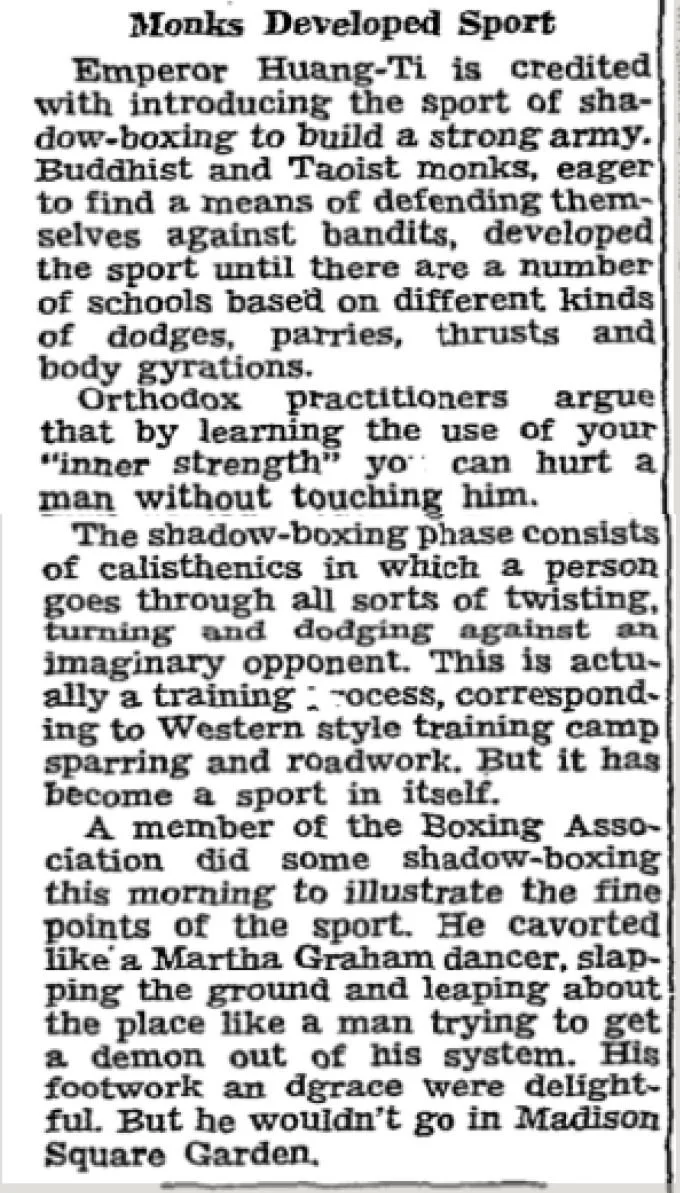
Monks Developed Sport
Emperor Huang-Ti is credited with introducing the sport of shadow-boxing to build a strong army. Buddhist and Taoist monks, eager to find a means of defending themselves against bandits, developed the sport until there are a number of schools based on different kinds of dodges, parries, thrusts and body gyrations.
Orthodox practitioners argue that by learning the use of your “inner strength” you can hurt a man without touching him.
The shadow-boxing phase consists of calisthenics in which a person goes through all sorts of twisting, turning and dodging against an imaginary opponent. This is actually a training process, corresponding to Western style training camp sparring and roadwork. But it has become a sport in itself.
A member of the Boxing Association did some shadow-boxing this morning to illustrate the fine points of the sport. He cavorted like a Martha Graham dancer, slapping the ground and leaping about the place like a man trying to get a demon out of his system. His footwork and grace were delightful. But he wouldn’t go in Madison Square Garden.
Original 1947 New York Times Article - 1
Original 1947 New York Times Article - 2
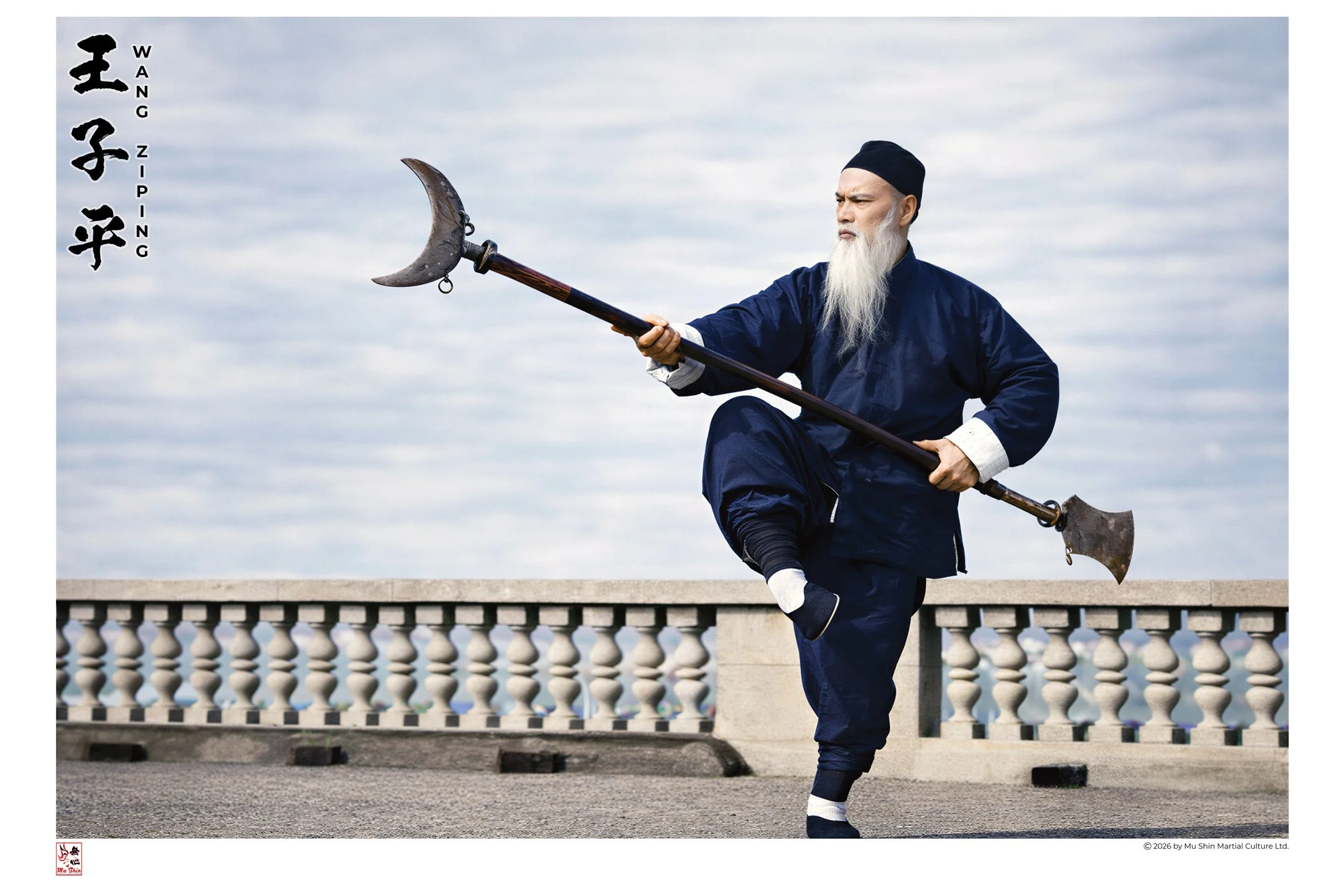
Strength. Discipline. Legacy.
Wang Ziping (1881–1973) stands as one of the most important martial artists of modern Chinese history. Born in Cangzhou into a renowned Hui Muslim martial family, he became known nationwide for his extraordinary feats of strength, refined skill, and unshakable moral character.
From early Republican-era strength exhibitions to leadership within the Central Guoshu Institute, Wang Ziping helped shape the modernization of Chinese martial arts at a pivotal moment in China’s history. His name became synonymous with discipline, resilience, and national renewal — a bridge between the world of the traditional jianghu and the emergence of modern Chinese physical culture.
This poster captures the presence and spirit of a man whose legacy extended across dynasties, political upheaval, and generations — carried forward by his family and students around the world.
Printed in high resolution with rich detail and historical depth, this piece is more than wall art.
It is a tribute to a martial artist who stood at the crossroads of legend and history.
NOTE:
Should your country of delivery not display at checkout, please do contact us directly to process your order.
Should you wish to use expedited delivery such as Fedex etc. please do contact us directly to process your order.
Should you want to order more than one poster in a single order, contact us directly to confirm your shipping cost.