Dancing, Prancing and Boxing: A 1928 Western Glimpse of Kung-Fu in Tibet - The North China Herald (4)
Introduction
In this continuing series looking at old Western newspaper reports on Chinese martial arts during the Republican era, we have another interesting article from The North China Herald, published on September 15, 1928.
Tachienlu, better known historically as Dajianlu and today as Kangding, occupied an important place on the Sino-Tibetan frontier. It was a meeting point of Chinese and Tibetan culture, trade, religion, and politics. With that in mind, this article is especially interesting, as it does not describe martial arts in one of the more obvious Republican-era centers such as Beijing, Tianjin, Shanghai, or Nanjing. Instead, it gives us a small glimpse of how martial culture and physical training were appearing in a frontier town.
As is often the case with Western newspaper reports of this period, the tone is somewhat amused, condescending, and mocking. The correspondent repeatedly refers to the activity as “dancing” and “prancing,” which is dismissive of the practice. More importantly, however, it also shows how little the writer himself understood about the structure of Chinese martial practice, which heavily emphasizes individual training, routine practice, and repeated body-conditioning methods. To the untrained eye, such practice may easily appear to be some type of “dance.” The author is observing from the outside and interpreting what he sees through his own assumptions.
In spite of this, the article preserves several valuable details.
It states that a society was formed for the “preservation of national boxing,” with one of the local temples being used as a meeting place.
This small detail is important. The phrase “national boxing” places the activity directly within the broader Republican-era movement to reframe Chinese martial arts as a form of national physical culture under the term Guoshu/Kuoshu. During this period, martial arts were increasingly being promoted not merely as methods of fighting, but as tools for strengthening the body, cultivating discipline, and reviving national spirit. In many places, these arts were being organized into societies, taught in schools, connected with military training, and supported by local officials.
The fact that the local temple was being used as a meeting place for training brings to light another important aspect of Chinese martial arts history. While there is a common misunderstanding that many of these arts were developed in temples and then spread outward from there, the reality is often quite different. Temples were historically among the few places that had open spaces suitable for groups to practice. This was not necessarily connected to the religious disposition of the practitioners, but rather to the practicality of the space and its location within the local community. Historically, we often see martial arts going into temples for this exact reason, not the other way around. In this article we see an account of how this happened organically.
The article also states that local officials were taking an interest in the movement and giving it their patronage. This suggests that what the correspondent witnessed was not simply a few young men playing at martial arts, but a broader community enthusiasm for organized martial training.
The article also captures a common anxiety of the Republican period, namely the fear that old practices might disappear. The writer notes that “there is some fear that this old-time art may be lost, hence its resuscitation.” This is precisely the kind of language we often see during the Republican era, when many traditional practices were being reclassified, reorganized, and preserved under new modern frameworks.
In spite of the writer’s condescending tone, he does state that the movement is “highly commendable” because it preserves an ancient art, teaches young men control of the body, and unites them in a common society. He further notes that the practice should produce “some good hard useful muscle in the young men.” With that, he hits the nail on the head regarding the multi-faceted benefits of Chinese martial arts practice, particularly in a communal sense, and I could not agree more with him.
For students of Chinese martial arts history, this little article is another reminder that the Republican period was a time of transformation. Martial arts were being reimagined, repackaged, and publicly promoted as part of a larger project of physical and national renewal. Even in a frontier town like Tachienlu, far from the major urban centers, this movement was clearly being felt.
Here I present the article in full.
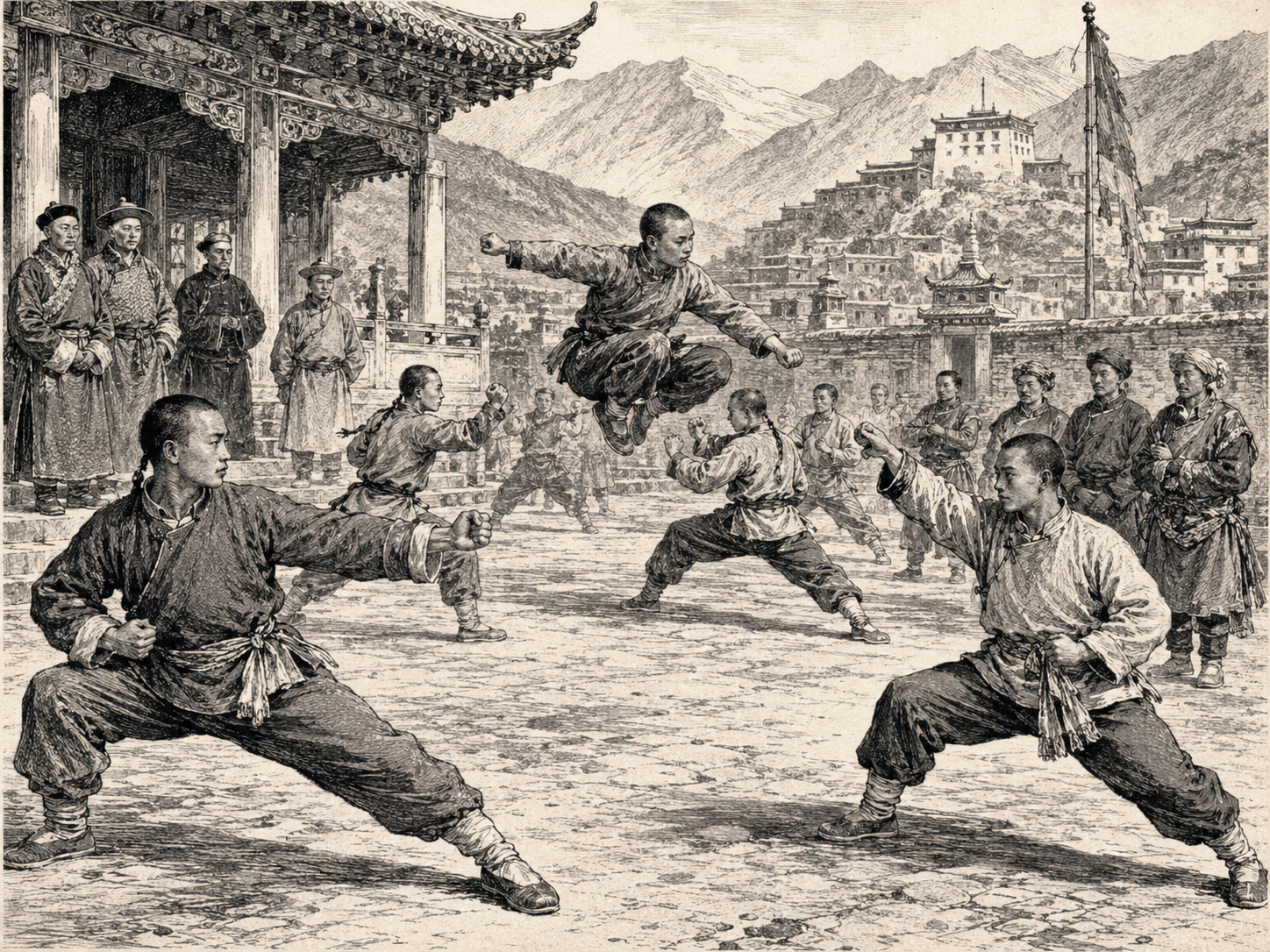
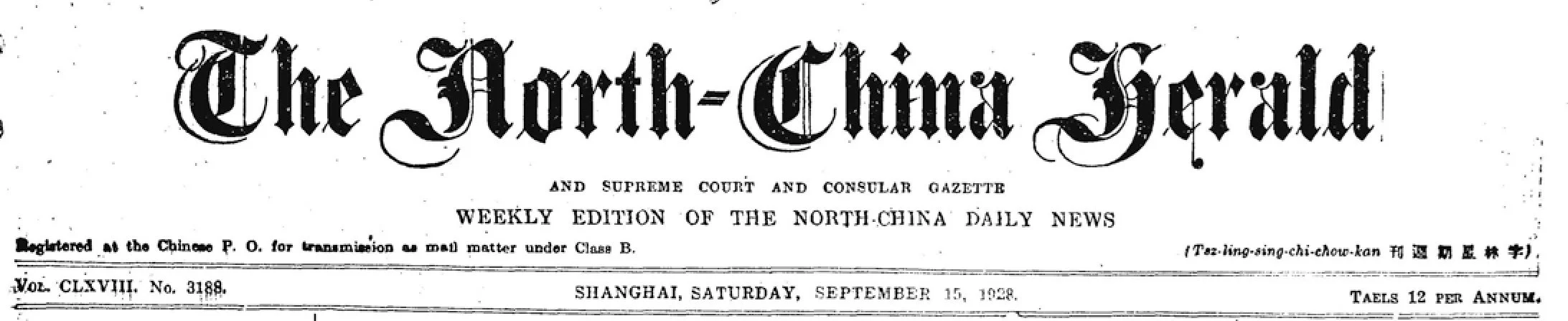
Re-created image (not from orignal publication)
DANCING PRANCING AND BOXING
Tibet Revives the Ancient Arts of Self-Defence
FROM OUR OWN CORRESPONDENT
Tachienlu, Aug. 11.
About three weeks ago the young men of Tachienlu took violently to an old system of dancing. In one of the military camps in the town a young fellow professed to be able to teach dancing, prancing and boxing. The system now taught includes all these three things. Immediately a society was formed for the preservation of national boxing and one of the temples secured as rendez-vous. Some of the necessary outfit has been obtained, including Ping-pong, and the members of the society are now getting up very early in the morning and going through numerous exercises.
Practically all the young Chinese in the schools and in the military and civil public offices are connected with this boxing society. The local officials are also taking some interest in the movement and giving it their patronage. The minor element in the town is not slow in following the major and small boys all over the city may now be seen jumping one foot high and three feet long and landing in an attitude of alarming self-defence. Before the jumper lands the arms swing in quick motion and the correct position is thus attained. The older members of the society, not agile as the younger, confine their prancing to the privacy of their upstairs bed-rooms.
Formerly this form of exercise was very largely confined to the theatre, the work of actors fighting the Three Kingdom battles over again. There is some fear that this old-time art may be lost, hence its resuscitation. As far as one can see the whole movement is highly commendable: it preserves an ancient art; it teaches the young men the control of the body; it unites in a common society the young men of the town. Provided the schoolboy does not neglect his books, the merchant his business, the official his office, the movement should produce some good hard useful muscle in the young men.
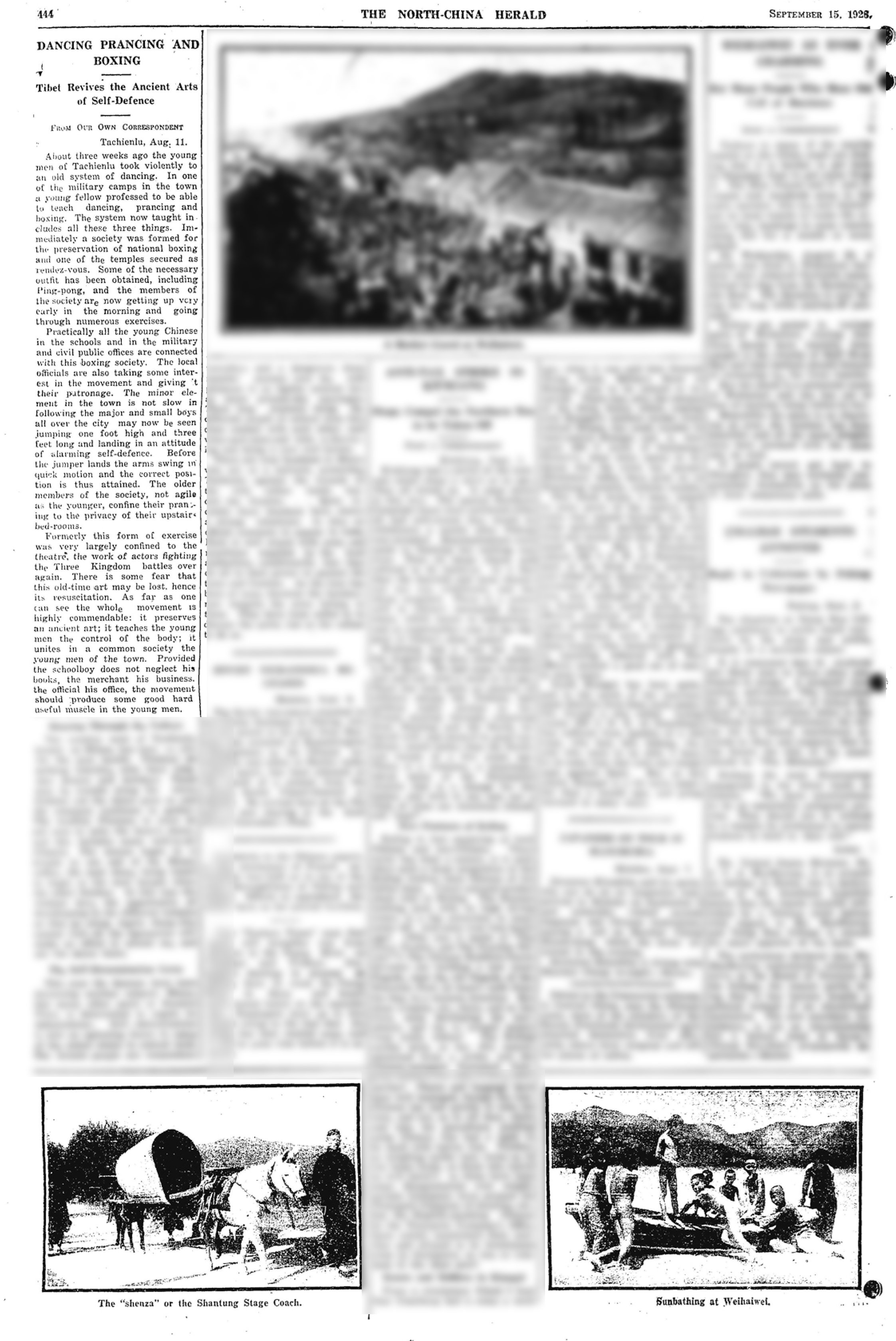
Original article (1)

This tee pays tribute to the golden age of martial arts video games, drawing inspiration from the iconic cover art of a classic Kung-Fu game we grew up on in the 80s. Featuring bold pixel art of the legendary Bagua “Hei Xiong Fan Bei – Black Bear Turns Back” technique, along with nods to the unforgettable visuals and icons of that era, this design hits hard with retro flair. On the back, the words “Bagua Zhang” appear in pixelated Chinese characters, just like they would've in the heyday of 8-bit action. Because let’s face it—old school is still the best school.
Available in black
See size chart for sizing