

Kung Fu on the Thames: Chinese Martial Arts Aboard the Keying in 1851 - The Illustrated London News
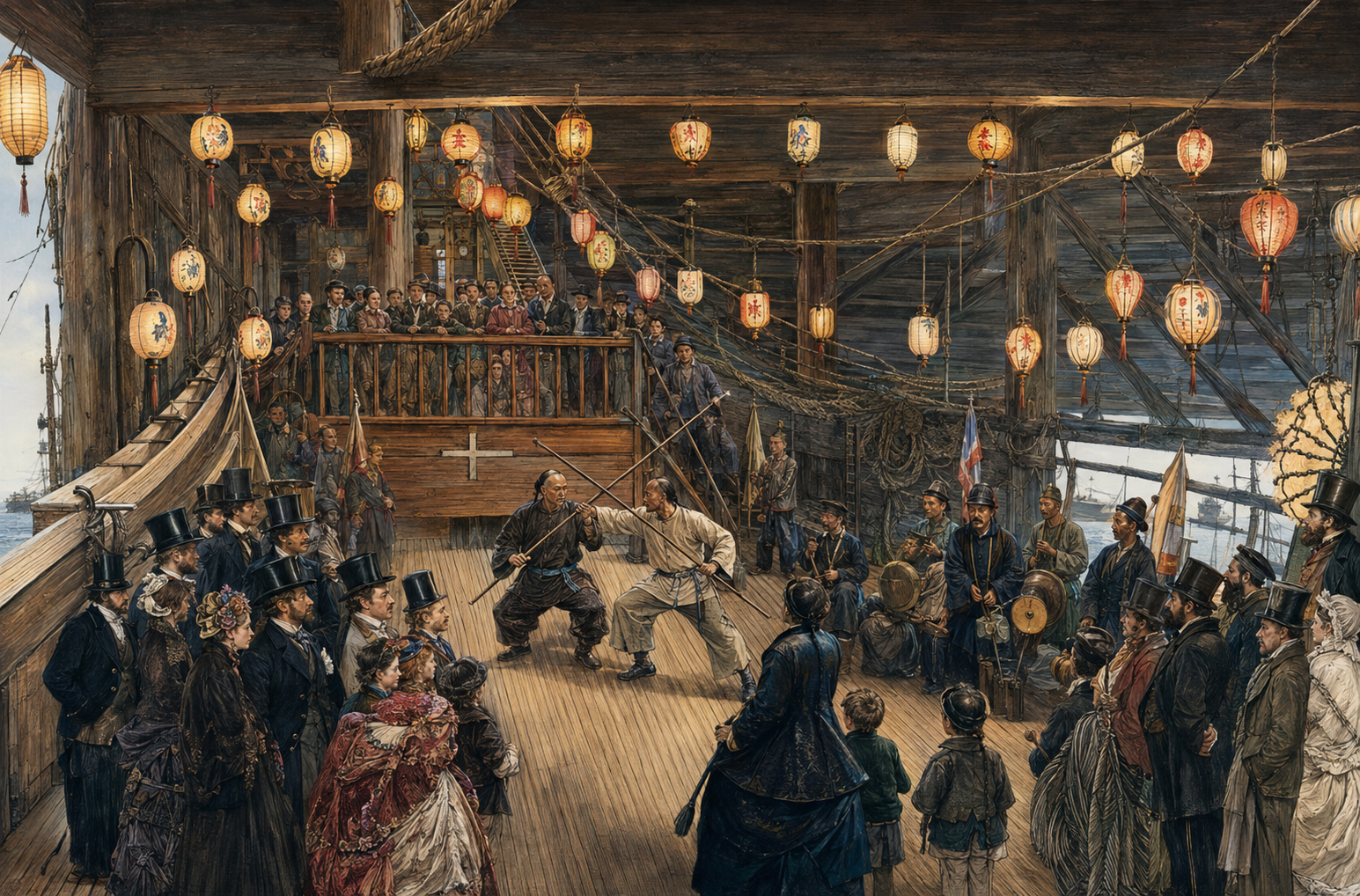
Recreation of the original image published on August 2, 1851
On 2 August 1851, The Illustrated London News published an unusual account of a public performance aboard the Chinese junk Keying, then moored near Essex Street on the Strand. Before an assembled London audience, members of the ship’s Chinese crew presented what the newspaper described as “war demonstrations and feats of arms.”
The performance began with individual unarmed routines and these were followed by demonstrations with “long poles or lances,” a paired weapon bout, swordplay and the use of a shield. Music and percussion accompanied the proceedings, as is very common in Chinese martial arts performances in Southern China.
Although the journalist dismissed much of what he witnessed as “grotesque posturings,” his description is recognisable as a programme of traditional Chinese martial performance. The report offers a rare early account of Chinese martial arts being demonstrated before a paying British audience, decades before they became familiar to the wider Western public.
The setting for the performance was no less remarkable than the display itself.
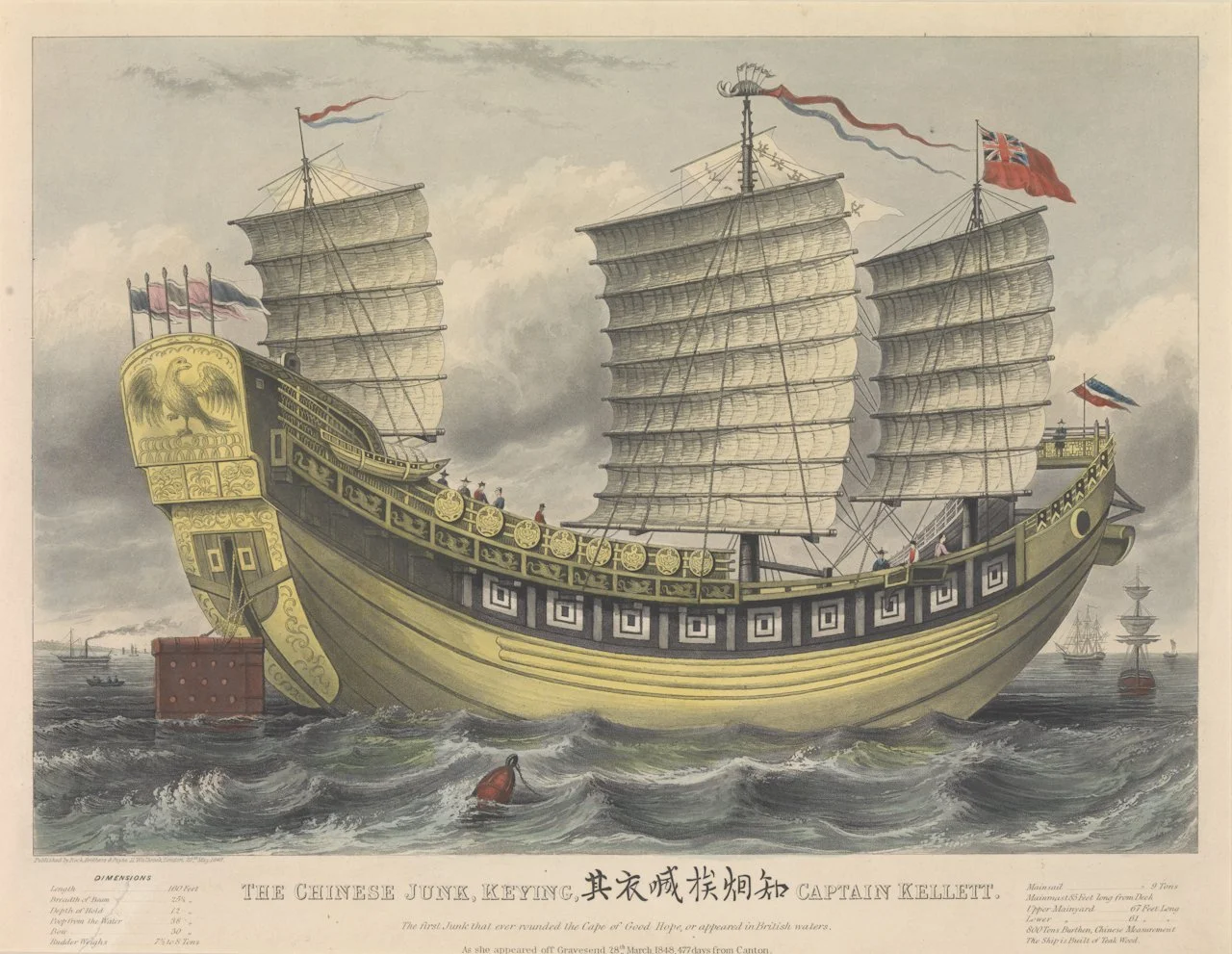
The Chinese Junk Keying
The Keying, named after the Qing statesman Qiying 耆英, was a large, three-masted Chinese trading junk built at Fuzhou. Contemporary sources give varying measurements, but she was approximately 160 feet long, displaced between 700 and 800 tons, and was constructed principally from teak. Although her precise age is uncertain, she was not built specifically for the voyage to the West and may already have been several decades old when purchased.
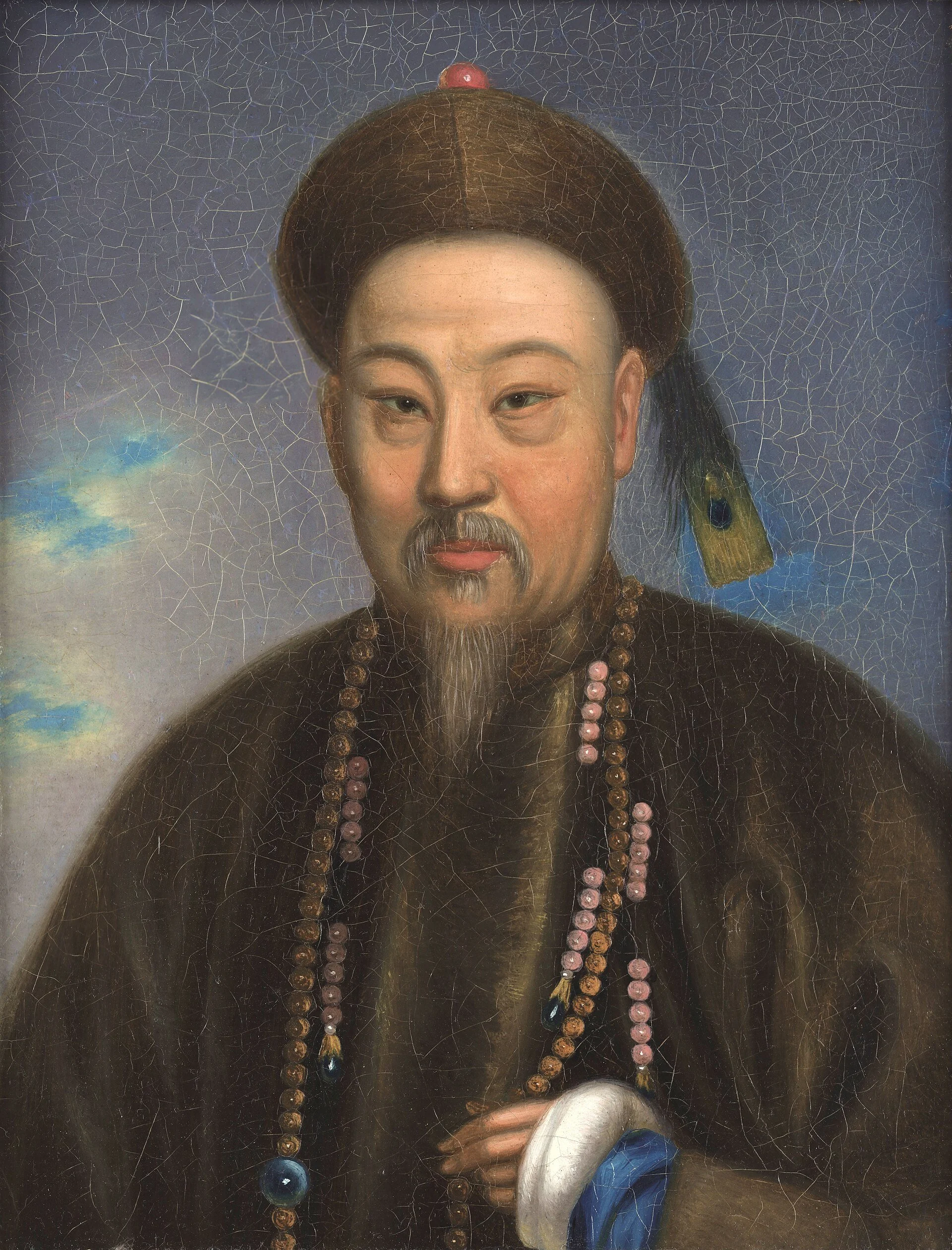
Qing Statesman Keying 耆英 (Born 1787 - Died 1858)
The vessel was secretly acquired by a group of British businessmen in Hong Kong in 1846, contrary to Qing restrictions on the sale of Chinese ships to foreigners. Their purpose was not primarily commercial navigation. The Keying, its furnishings and its Chinese company were intended to form a travelling exhibition through which Western audiences could encounter what was promoted as an authentic representation of China.
Under the command of the British master mariner Charles Alfred Kellett, the Keying departed Hong Kong on 6 December 1846 with a mixed crew commonly reported as 12 British and 30 Chinese sailors. She crossed the Indian Ocean, rounded the Cape of Good Hope and reached St Helena in April 1847. From there, rather than sailing directly to Britain, Kellett took the vessel across the Atlantic to the United States.
The Keying arrived in New York in July 1847 and was opened to the public as a floating exhibition. Visitors paid to inspect its unusual construction, furnished interiors and collection of Chinese objects. The vessel attracted considerable attention and reportedly inspired the American showman P. T. Barnum to commission an imitation Chinese junk at Hoboken.
The voyage was not without controversy. During the ship’s stay in New York, members of the Chinese crew became involved in disputes concerning unpaid wages and the destination of the vessel. Several subsequently left. Their experiences complicate later descriptions of the voyage as a straightforward act of cultural exchange. The Keying was a British-owned commercial venture, while the Chinese sailors whose presence gave the exhibition its appearance of authenticity occupied a considerably less secure position within it.
After several months in New York and a further period in Boston, the Keying crossed the Atlantic and reached British waters in March 1848, 477 days after leaving Hong Kong. The MIT Museum describes her voyage as the first and possibly the only instance of a Chinese junk sailing independently from China, around the Cape of Good Hope and into the North Atlantic. Whatever qualifications may be required concerning claims of priority, the journey remains a considerable achievement in maritime history and demonstrated the seaworthiness of a vessel whose design was unfamiliar to most Western observers.
In London, the Keying was initially berthed at the East India Docks at Blackwall and exhibited under the name “Royal Chinese Junk.” For an admission fee, visitors could inspect the vessel, its grand saloon and displays of Chinese furniture, clothing, artwork, weapons and other objects. Advertisements also promised an encounter with a “Mandarin of rank” and a celebrated Chinese artist. Queen Victoria, Prince Albert, the Duke of Wellington and Charles Dickens were among those who visited.
The supposed mandarin was a Chinese member of the company named He Sing. Later research has cast considerable doubt upon the rank attributed to him, suggesting that the title formed part of the exhibition’s commercial presentation. He Sing nevertheless became a public figure in his own right and appears to have been one of the performers aboard the vessel. In 1851, he famously appeared at the opening of the Great Exhibition and was incorporated into the ceremonial procession, walking between the Archbishop of Canterbury and the Comptroller of the Royal Household.
As public interest declined, the Keying was moved from Blackwall to a position near Essex Street on the Strand. By 1851, the vessel had been adapted into a more conventional entertainment venue. Its Chinese company gave scheduled performances involving music, singing, conjuring, dancing and what advertisements called a “grand assault of arms.”
The Keying was eventually sold at a substantial loss and towed to Rock Ferry on the Mersey in 1853, where it continued briefly as a public attraction. It was subsequently dismantled, ostensibly for study, and pieces of its teak were fashioned into souvenirs. By 1855, the remaining structure was reported to be lying “neglected and uncared for” at Tranmere Ferry.
The vessel’s physical existence had come to an unremarkable end. Its historical importance, however, extended beyond its celebrated voyage. Through the Keying, British and American audiences encountered a carefully staged representation of Chinese martial culture and, as the report published in The Illustrated London News reveals, one of the earliest documented public displays of Chinese martial arts in Britain.
The following transcription presents the original report in full. Its dismissive and racialised language reflects the attitudes of the unnamed Victorian correspondent and is reproduced here as part of the historical record.
CHINESE PERFORMANCE ON BOARD THE JUNK
The Chinese Junk being now, by permission of the civic authorities (the conservators of the river), firmly established on the mud-bank at the end of Essex-street, Strand, close to the outfall of the main sewer of St. Clement’s parish, is thrown open daily—morning and evening—with a variety of entertainments à la Chinaise, including a vocal and instrumental concert, a grand assault of arms, Chinese conjuring tricks, &c.
The native crew, who, of course, never contemplate going to sea again, are the performers, and acquit themselves in an artistic manner worthy of the “supers” of the Victoria or Astley’s. At the evening performances the queer old craft is lighted up with festoons of coloured lamps—a sort of miniature Vauxhall; and in the midst stands an open orchestra, in which four or five instrumentalists (“Barbarians,” not Chinese) prepare the ear for the extraordinary combination of sounds which is to follow.
Nothing can exceed the gravity of the “celestials,” as they take their position in the midst of the assembly on the main-deck, and proceed to fright the ear with gong and drum, and cymbal, and agonizing cat-gut; the leader beating time with a stake upon a sort of tin sauce-pan-lid supported on three legs. Then the vocalisation! The extraordinary squeaking duet, half plaintive, half comic, between the said leader (who is a sort of Costa and Mario rolled into one) and a younger aspirant in the background—what pen can possibly convey its harrowing and ludicrous effect? Nothing except that impromptu feline discourse which we sometimes hear on house-tops at dead of night.
The concert being concluded amidst the breathless silence of an astonished auditory, the war demonstrations and feats of arms then commence; and these are certainly no less extraordinary than what has gone before.
The first act consists of a set of grotesque posturings, in which the performers disport themselves severally one after the other, each succeeding one striving to outdo the other in the wildness and extravagance of his gestures—flying and leaping round the deck, thrusting out the arms right and left, threatening, retreating, &c., the musicians all the time keeping up a terrific clang.
Next come a series of somewhat similar performances, with long poles or lances; this scene closing with a set-to between two performers, which we have endeavoured to embody in our Engraving. Swords are also introduced, and brandished about in the same manner, which, if intended to give any idea of the military science of the Chinese, shows them to be very far behind any other known nation in the world in that respect.
One young hero, in the course of his “war demonstrations,” afforded great amusement every now and then, particularly after some very startling efforts at cut and thrust, by throwing himself down, and turning a somerset over his shield. When we left, the “barbarian” orchestra was about to strike up again, and dancing, it was said, was about to commence, but we did not wait for it.
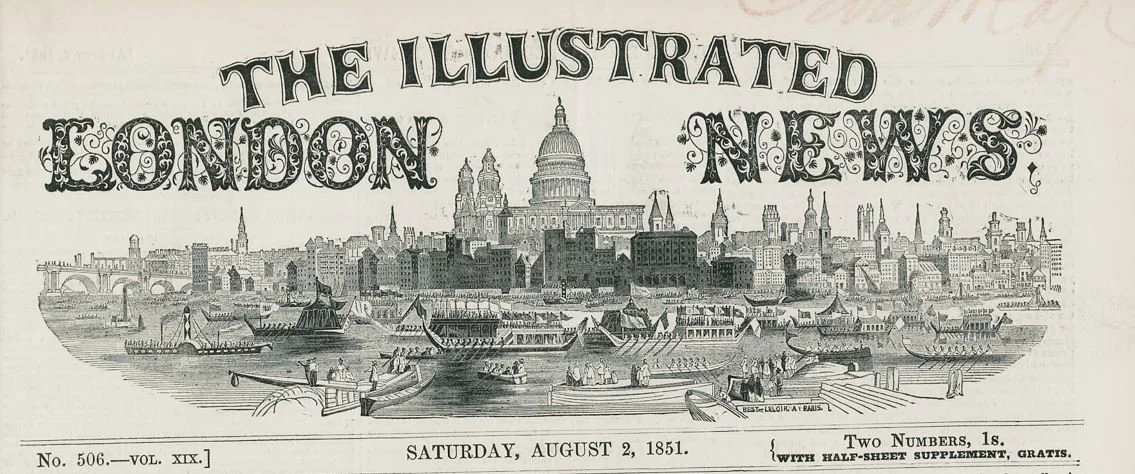
—The Illustrated London News, no. 506, vol. XIX, 2 August 1851, p. 148.
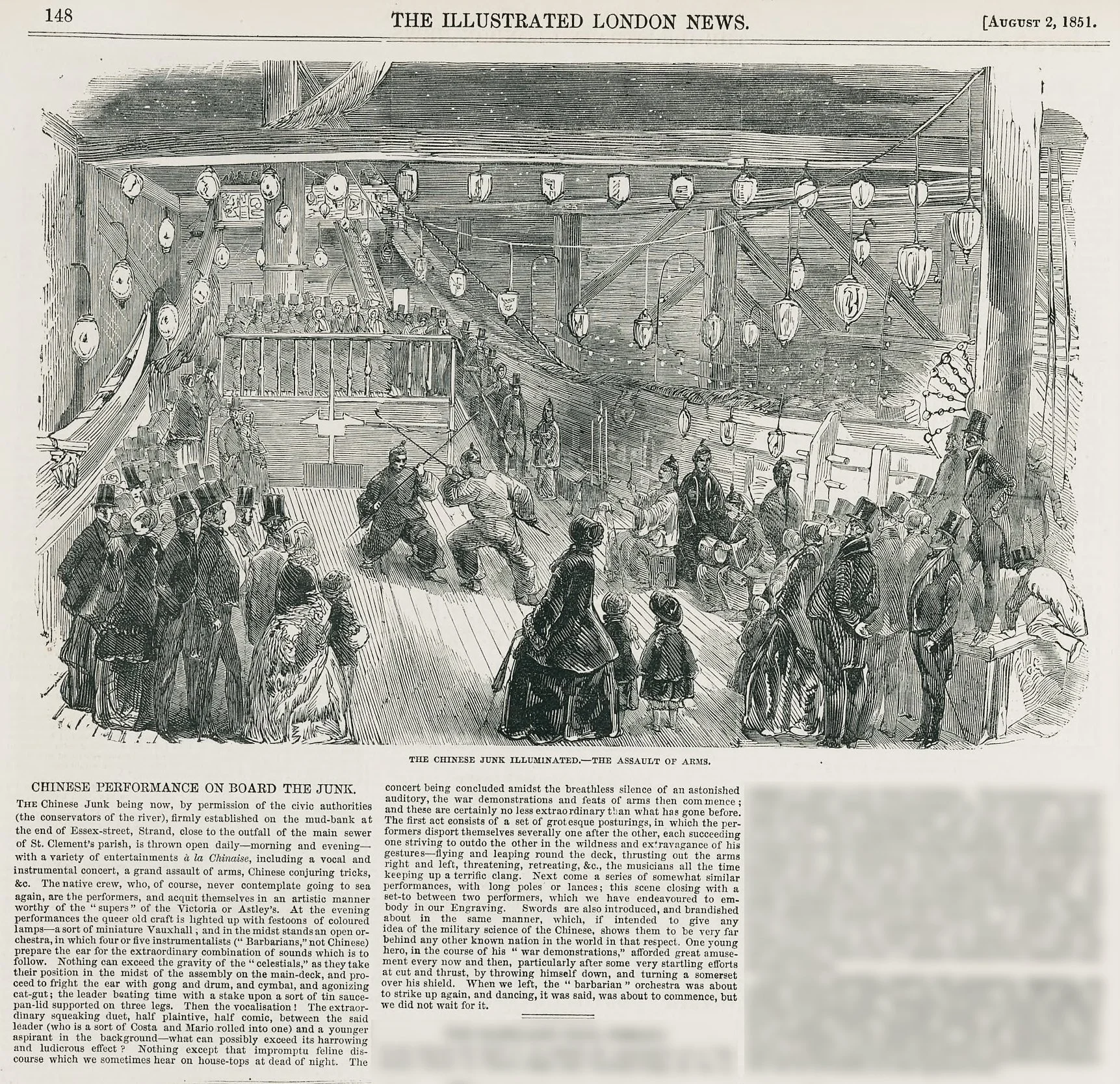
The original article as it appeared
Martial Arts Through Victorian Eyes
The report is marked by a dismissive attitude towards both the performers and the culture they represented. The journalist describes the unarmed routines as “grotesque posturings,” characterised by “wildness and extravagance,” while reducing the accompanying music to incomprehensible noise.
The performers are repeatedly called “celestials.” The term derived from “Celestial Empire,” a Western rendering associated with the Chinese concept of Tianchao 天朝, the “Heavenly Dynasty.” By the 19th century, however, “Celestial” had become a racialised term for Chinese people, often carrying patronising or derogatory connotations. Its use here reinforces the reporter’s presentation of the crew as objects of exotic amusement.
Much of the ridicule arose from his inability to understand what he was witnessing. Lacking the necessary terminology and cultural knowledge, he interpreted structured routines, weapon sets, paired practice and percussion as random gestures and theatrical absurdity.
Such judgements reflected the imperial confidence of Victorian Britain following its victory over Qing China in the First Opium War. The account must therefore be read critically. Its importance lies in the activities it records, not in the conclusions of its author. The journalist documented a significant early display of Chinese martial arts in Britain, but lacked the knowledge and perhaps the willingness to understand what he saw.
The Sabre and Shield
One of the most revealing passages concerns a performer who, after several actions of “cut and thrust,” threw himself to the deck and turned “a somerset over his shield.” The journalist presents this as a comic flourish intended to amuse the audience. In fact, the movement is consistent with established Chinese sabre-and-shield practice.
Although the report uses the general term “sword,” the weapon was more likely a single-edged Chinese sabre, or dao 刀. When used together, the shield protected the body while the sabre delivered cuts at close range. Rolling and other low evasive movements allowed the practitioner to remain covered, pass beneath or around an opponent’s weapon, close distance and rise into an immediate attack.
Far from being an irrelevant acrobatic display, the roll observed aboard the Keying may therefore have demonstrated a practical method of entry. The shield provided mobile protection throughout the movement, enabling the practitioner to advance from an unexpected angle before striking with the sabre.
This episode illustrates the central limitation of the report. The correspondent accurately recorded an unusual movement but, lacking knowledge of the weapon system, interpreted a recognisable tactic as comedy. What appeared to him as a “somerset” was likely an integrated defensive and offensive action—one designed to evade, cover, enter and counterattack in a single continuous movement.
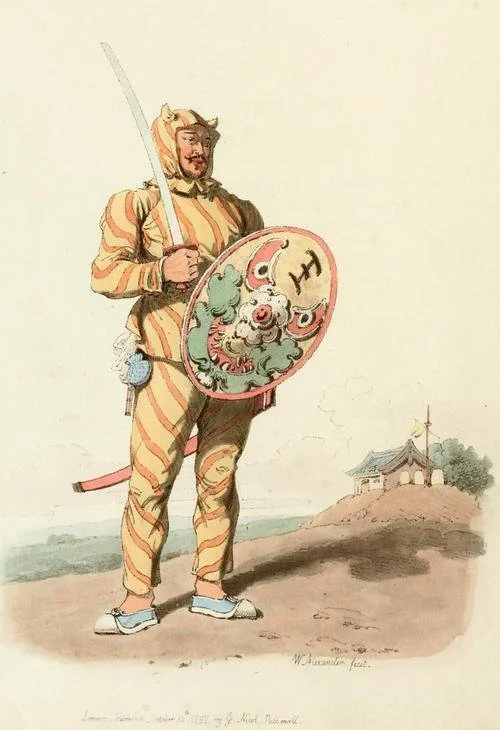
A “Tiger of War"- William Alexander's book "Costumes of China"
Despite its condescending tone, the report preserves an important moment in the history of Chinese martial arts in Britain. Its descriptions of unarmed routines, pole weapons, paired practice, sabre-and-shield methods, acrobatics and percussion remain recognisable more than 170 years later.
The demonstration shows that Chinese martial arts reached British audiences long before terms such as kung fu and wushu became familiar in the West. Although presented as commercial entertainment, the performance nevertheless allowed the Keying’s Chinese company to demonstrate elements of their own martial culture before a large foreign audience.
Not every spectator would necessarily have shared the reporter’s contempt. Some may have recognised the performers’ discipline and physical skill, or left with a new interest in Chinese fighting methods. Viewed beyond the journalist’s prejudices, the “assault of arms” aboard the Keying represents a significant early encounter between Chinese martial culture and the British public.

Liang Style Bagua Zhang Volume One: Foundational Practices presents the history, principles and essential training methods of Liang Style Bagua Zhang. Written by fourth-generation master Di Guoyong and translated, co-authored and edited by his disciple Byron Jacobs, this volume provides a structured introduction to the system and its traditional practice.
The book traces the origins and development of Bagua Zhang before examining the formation of the Liang style through its founder, Liang Zhenpu. It follows the transmission of the system through successive generations and includes Di Guoyong’s personal account of studying under the renowned master Li Ziming.
The instructional chapters introduce the fundamental practices used to establish the body method, stepping, coordination and principles required for further study. Particular attention is given to the Eight Fixed Posture Palms, an important foundational practice within Liang Style Bagua Zhang.
Clear explanations, detailed illustrations and supporting video references help readers study the movements and underlying principles. The material is suitable both for practitioners beginning their study of Liang Style Bagua Zhang and for experienced martial artists seeking a deeper understanding of the system’s foundations and lineage.
This volume includes
The origins and historical development of Bagua Zhang
The life of Liang Zhenpu and the formation of the Liang style
The transmission of the Liang lineage through successive generations
Di Guoyong’s experiences studying under Li Ziming
Essential principles and foundational training methods
Detailed instruction in the Eight Fixed Posture Palms
Illustrations and supporting video references
Book details
Authors: Di Guoyong and Byron Jacobs
Language: English
Paperback: 224 pages
Interior: Black and white
Dimensions: 156 × 234 × 14 mm
Weight: approximately 480 g
ISBN: 978-9925-8003-4-6
Publication date: May 2025
Shipping and combined orders
If your delivery destination is not available at checkout, please contact us directly. Expedited delivery options such as FedEx may also be arranged on request.
For orders containing multiple books, contact us before purchasing so that we can confirm the most suitable combined shipping rate.
Liang Style Bagua Zhang Volume One: Foundational Practices
Discover the foundations of Liang-style Bagua Zhang in this authoritative guide by fourth-generation master Di Guoyong. Covering the art’s history, lineage, essential training methods and Eight Fixed Posture Palms, the book combines detailed instruction, illustrations and supporting video references.
Translated, co-authored and edited by fifth-generation practitioner Byron Jacobs.
References
“When a Chinese Junk Came to Manchester” - https://mmhellofuture.wordpress.com/2020/06/25/when-a-chinese-junk-came-to-manchester/
“Sailing Through Time: A Chinese Junk Ship’s Voyage to Victorian England” - https://www.kyliefennell.com/sailing-through-time-a-chinese-junk-ships-voyage-to-victorian-england/