Liang Zhenpu: A Rare Bagua Zhang Biography by Huang Bonian
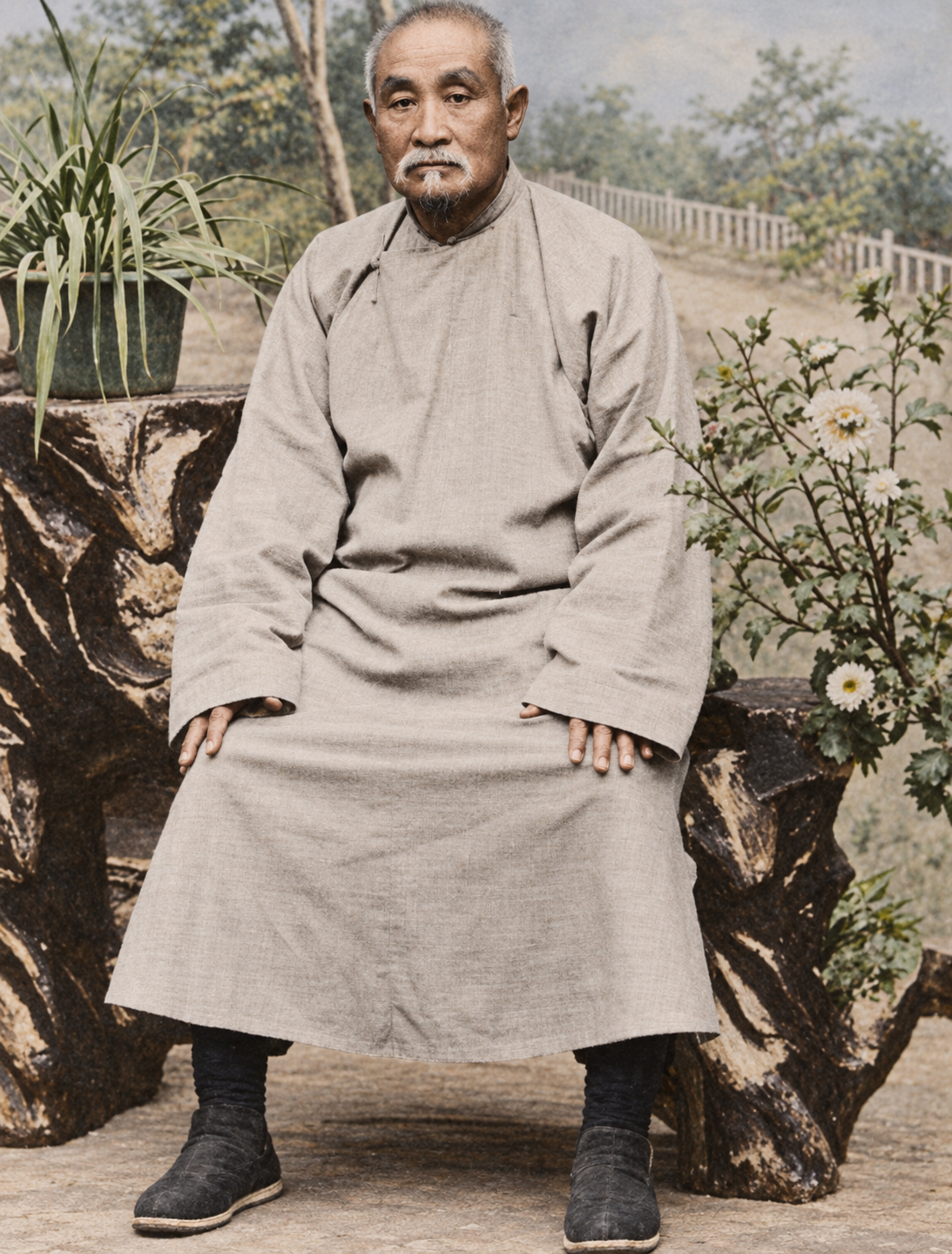
Digitally restored and colorized portrait of Liang Zhenpu 梁振蒲 (Born 1863 - Died 1932) in later life
Liang Zhenpu: Skill, Character and the Martial World of Late Qing China
Liang Zhenpu 梁振蒲 was the youngest of Dong Haichuan’s better-known disciples and the founder of the Liang branch of Bagua Zhang that would later be transmitted through figures such as Guo Gumin and Li Ziming. Li Ziming being my direct grand-teacher, who taught my Shifu, Di Guoyong 邸囯勇.
Much of what is now written about Liang consists of brief biographical summaries, lineage accounts and stories repeated many decades after his death. The following biography is therefore particularly valuable. It comes from Huang Bonian 黄柏年, a disciple of the renowned Xingyiquan master Li Cunyi 李存义, and records not only stories concerning Liang’s martial abilities but also Huang’s personal recollections of meeting him.
The account appears in Huang’s Record of the Lineages of My Mentors and Friends (Shi you Yuan Yuan Lu 师友渊源录), written during the Republican period and serialized in a newspaaper between 1930 and 1934. It presents Liang not simply as a formidable fighter, but as the embodiment of an older martial ideal - - highly skilled yet restrained, courageous without being cruel, and respected as much for his character as for his physical ability.
As with many traditional martial biographies, the text combines personal testimony, inherited stories and tales as well as literary imagery. Its accounts of extraordinary physical feats should be read within that context. Additionally, some of the account is in direct contrast with what we know to be factual regarding Liang Zhenpu’s life. Nevertheless, it offers a rare window into how Liang Zhenpu was remembered by people who belonged to the same wider martial community. The work appears to have circulated through a Republican-era newspaper serialization. I have been unable to find an actual scan or the original Liang Zhenpu instalment as yet and was rather sent this transcrptoin by my martial-family member, which I have translated below. The surviving transcription contains several characters and place names that may reflect copying errors. The translation should therefore be described as being based on the currently available Chinese transcription rather than a verified original newspaper scan.
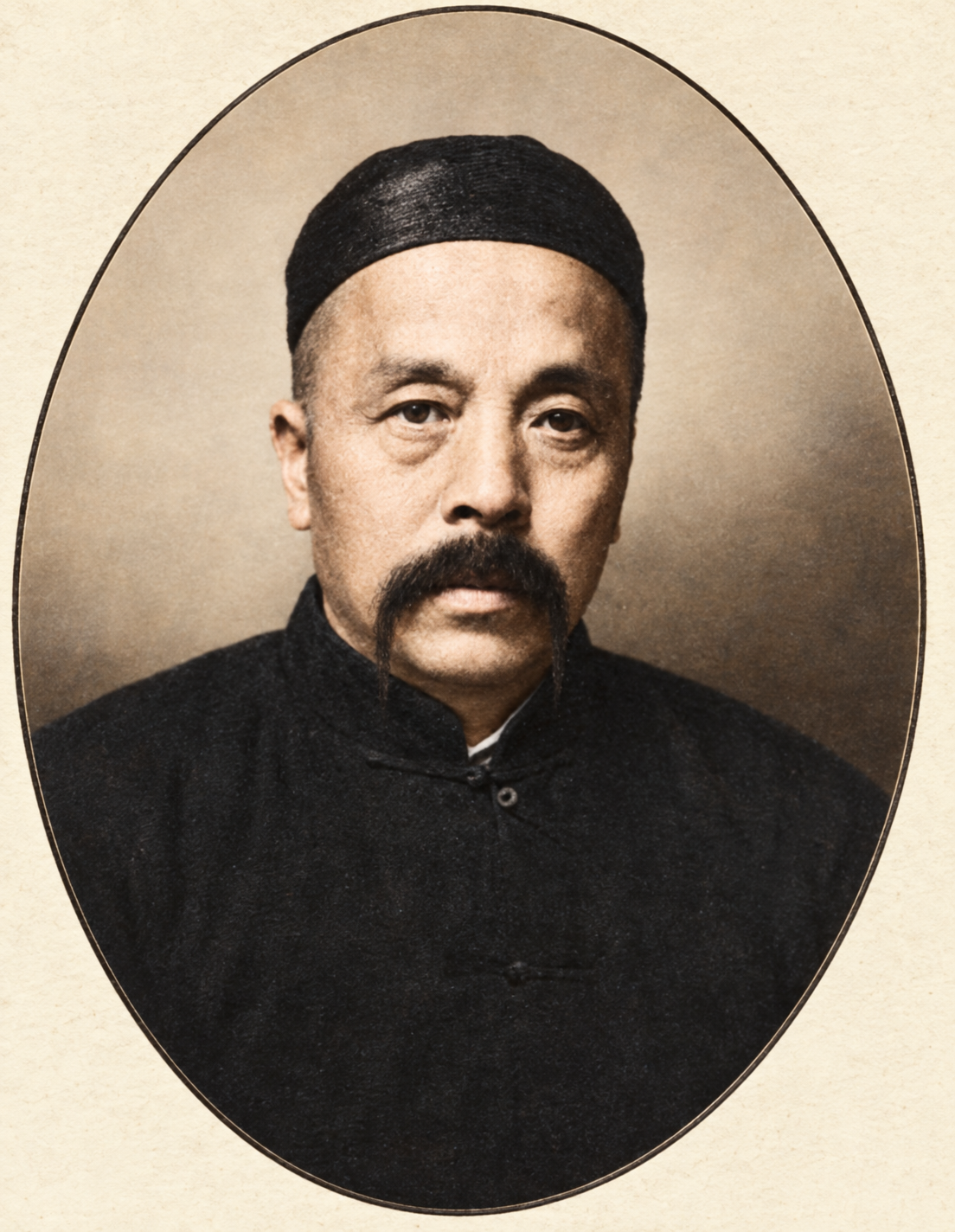
Huang Bonian (1880–1954), author of this account of Liang Zhenpu. Portrait digitally restored and colorized; the colors are interpretive.
A SHORT BIOGRAPHY OF LIANG ZHENPU
Excerpted from A Record of the Lineages of My Mentors and Friends (Shiyou Yuanyuan Lu), by Huang Bonian, a disciple of Li Cunyi - Translated by Byron Jacobs
My late teacher once said:
“Among all my fellow disciples, the youngest yet most accomplished in his art was Mr Liang Zhenpu of Jizhou.”
Mr Liang was a native of Zhongshang Village in that district. His family had engaged in commerce for generations and had become prominent merchants throughout the regions of Yan and Zhao. Naturally intelligent and fond of learning, Liang was particularly fascinated by the arts of boxing and armed combat.
Together with the Xingyiquan practitioner Mr Si Gentiao, he invested in the establishment of a textile shop in Wu. Year after year, he travelled throughout the regions north and south of the Yangtze River, constantly seeking out accomplished teachers, yet for a long time he failed to meet anyone who satisfied him.
After some years, he heard of the reputation of our grand-teacher Dong Haichuan and his Bagua Zhang. He and Mr Liu Miaoqing therefore presented themselves as disciples at Dong’s school. Liang attended his teacher’s instruction daily and received the authentic transmission of his art.
The consummate skill for which Mr Liang was particularly renowned was his ability to employ the circling, turning and surging momentum of Bagua Zhang footwork. Darting swiftly to the left and right, he could sweep the queue (Manchu ponytail) of his hair across an opponent’s eyes, striking them without fail. From this alone, one may imagine the speed of his movements and the agility of his body.
Throughout his life, however, he remained sincere, modest and never used his skill as a reason to act arrogantly towards others.
Some mischievous young men in Beijing wished to test his abilities. They waited until Mr Liang went out and then crowded around him, jostling and provoking him. At first, he did not become angry. He merely turned his body amidst the press of their shoulders, moving as lightly and unpredictably as the wind. Suddenly, a series of sharp snapping sounds was heard, and all those who had accosted him covered their faces and fled. Wherever Mr Liang’s queue had struck, their eyes and noses immediately began to burn and sting, and tears fell heavily from their eyes. Their wretched condition was beyond description. From that time onward, the name “Little-Queue Liang” became famous throughout the land.
On another occasion, after Mr Liang and Mr Si had finished selecting merchandise, they agreed to take an excursion on the lake. It was late spring, the weather was mild and the breeze gentle, and the lake was crowded with visitors.
Mr Liang was leaning against the side of the boat, gazing into the distance, when he suddenly noticed several small boats a few acres away surrounding and obstructing another vessel in the middle of the lake. Whenever the wind carried the sound across the water, loud laughter could be heard. Suspecting that something was wrong, he ordered the boatman to draw closer so that they could investigate.
When they arrived, they saw more than ten ruffians divided among several small boats, chasing one another around a pleasure barge. Their obscene language and licentious behaviour were so vulgar that it was unbearable to see or hear. A middle-aged woman and several young women aboard the barge were huddled together in terror, not knowing what to do. Realising that they were the womenfolk of a respectable family, Mr Liang sprang to his feet in fury. Mr Si attempted to restrain him, but it was already too late. Liang had leapt onto the prow of the boat and sternly ordered the ruffians to stop.
Having been acting without the slightest restraint, the men glared at the person who had dared to interfere. They saw that he was short and small in stature, and from his speech they recognised the accent of Yan and Zhao. Observing that he had few companions in his boat, they began shouting abuse. Their poles and oars flew at him from every direction.
Unable to contain his anger, Mr Liang seized a boat pole and swept it horizontally through them. Several men immediately fell into the water, while the remainder recoiled in alarm. The water was deep and the tide high, and the men of Wu were generally accustomed to swimming, so none of those who had fallen in were drowned. The ruffians abandoned their boats, scrambled onto the bank and continued to shout and curse. They intended to lure Mr Liang ashore, where they hoped to take their revenge upon him.
Mr Liang understood their intention. Although his boat was more than ten feet from the bank, he crossed the distance in a single leap and landed directly in the midst of the crowd. All were terrified by this display. Their leader, a man surnamed Ma, realised that they could not defeat him. He ordered the others to withdraw, then approached Mr Liang, bowed and apologised. He even asked to become his disciple. Mr Liang examined his character, politely declined the request and departed. From that time onward, his name became famous throughout the region south of the Yangtze.
In the second year of the Xuantong reign of the Qing dynasty [1910], Mr Liang established a branch of his textile and clothing business in Zhengzhou. Once the basic arrangements had been made, he honoured me with a visit. Unfortunately, I was away at the time. When I returned, Mr Liang had already left. Upon seeing his calling card, I was overcome with regret. I then reflected that he could not have been gone for very long and that I might still be able to find him. I straightened my clothes and immediately went out again.
Zhengzhou occupied a vital position along the main north–south routes. Its streets were lined with markets and shops, while the timber trade was particularly prosperous. My home was close to the commercial district, and building timbers could be seen everywhere. I had walked only a short distance when, looking north towards the end of the street, I noticed a man sitting atop a stack of timber. He was holding a tobacco pipe and had stopped there briefly to rest. He was broad-waisted and short in stature, yet his eyes and bearing were clear and full of spirit.
I thought there was something extraordinary about him, but in the haste of the moment it was not convenient to question him. Although Mr Liang belonged to the senior generation of my own martial lineage, his business had taken him constantly between the north and south, so I had never had an opportunity to meet him formally. I had long heard of his reputation and had always feared that, if we happened to meet, I might fail to recognise and address him properly, allowing him to pass me by. Therefore, whenever I had the opportunity, I had asked my teacher about Mr Liang’s appearance and bearing.
While I was still hesitating, Mr Chang, the manager of the Changshun Armed-Escort Bureau, happened to approach from the south. I supposed that he might know Mr Liang. As he drew near, I raised my hand and asked him. The man was indeed Mr Liang.
I hurried forward and paid my respects. Mr Liang greeted me warmly, and we began to converse. At that moment, my junior martial brother Jiang Yuhe had just returned from escorting a consignment for the Ruixiang Armed-Escort Bureau. He was dressed in full martial attire and looked exceptionally imposing. I immediately told him that Mr Liang was present and instructed him to pay his respects.
Yuhe was young and impetuous. He grasped Mr Liang’s right arm and pulled forcefully, saying:
“Martial Uncle, you have travelled a great distance. Why not come to the escort bureau and rest?”
In reality, he wished to use this as an opportunity to test the strength of Mr Liang’s body.
Mr Liang replied solemnly:
“Thank you for your kind invitation, but I have no time today. Another day, perhaps.”
As he spoke, he lowered his elbow slightly. Yuhe suddenly felt all strength leave both his arms, and he was unable to move them.
Seeing what had happened, I understood what Mr Liang had done. I apologised, saying:
“Yuhe is young and behaves rashly. Martial-Uncle, as his elder, I trust that you can forgive him.”
Mr Liang smiled, rose and gave Yuhe a push, saying:
“Come along! Why are you standing there like a fool?”
We then returned to my residence together. When our fellow disciples heard that Mr Liang had arrived, they all came to pay their respects. Mr Liang was gentle and amiable by nature. Whatever questions they asked, he answered with detailed instruction.
He once said to me:
“The essentials of boxing do not extend beyond yin and yang and the Five Elements; movement and stillness; emptiness and fullness; advancing and retreating; rising and falling. If one practises diligently, there is nothing that cannot be accomplished.
“Yet one who studies the martial arts must understand the Dao, while the cultivation of life places the greatest value upon harmony. The Dao is the mother of wisdom, and harmony is the source of vital energy. If these two things are understood, wisdom will become perfectly rounded and courage will flow without obstruction.
“After a long period of cultivation, one will naturally be able to advance or withdraw as the mind desires, and hardness and softness will accord with one’s intention. One becomes expansive like Heaven and Earth, vast like the ocean, stable like the mountains and substantial like a great granary.
“These are all supreme states attained through the cultivation of qi. They cannot be comprehended by those who rely merely upon seizing and striking, blocking and evading, or leaping about to make a show of their physical strength.
“When crossing hands with another person, one must understand that if the opponent’s force is still distant, one does not advance against it. One must know what is far and what is near, what is broad and what is narrow. Body, mind and qi must unite as one. Move like a swimming dragon and rise as though bearing a heavy burden. Whether using the fist or the palm, apply whatever is appropriate to the circumstances, and there will be nothing that cannot be overcome.
“Strike high according to what is high; strike low according to what is low. To fight one’s way throughout the world, the posture should be like that of an old rooster.”
Mr Liang often repeated these words, particularly because he excelled in using the Chicken Form’s kicks.
Whenever Mr Liang faced an opponent, his mind remained relaxed and his body alert. Against a weak opponent, the force he used was scarcely more than a hair’s breadth. Against someone somewhat stronger, he still used only short techniques to gain control.
One of his methods was to pinch the opponent’s nose between two fingers and lead him away. The person would be forced to follow him step by step, completely unable to exert any strength. After giving the person this small warning, Mr Liang would stop and resume laughing and conversing as usual.
He had always possessed a sincere and generous nature. He did not wish to apply violent force to another person and thereby cause injury. For this reason, people both feared and respected him.
There was a man from Mao named Chen Delu, who possessed great physical strength and was skilled in combat. Mr Liang defeated him by this same method, after which Chen acknowledged himself as Liang’s disciple.
Mr Liang lived in Mao for a considerable time. Fellow members of the school, including Guo Yonglu, Sun Rujiang, Huang Zhenyuan, Qi Zhaojiang, Han Shuhui, Li Shuchun and Tian Shiliang, all studied and reviewed the art under him. Mr Liang instructed them whenever the opportunity arose and never showed favouritism. His fellow disciples, for their part, never dared to treat him without proper respect.
In recent years, Mr Liang has withdrawn from public life and lives quietly in his native village. Whenever one of our companions travels north and stops to visit him along the way, he still earnestly asks after the circumstances and well-being of the rest of us. His benevolent concern and affection for others may truly be called sincere.
Appraisal
I have heard it said that, at its highest level, the purpose of martial skill is to defend the nation’s borders against aggression; at the next level, it is to protect one’s own body. It is most certainly not something upon which one should rely to bully others or injure one’s fellow human beings.
Yet among those who practise the martial arts today, some will viciously attack others over the slightest grievance. There are even those who employ secret schemes and concealed blows to injure a person’s vital points. Such incidents occur all too frequently.
Consequently, ordinary people of cautious and honest character knit their brows and say to one another:
“This art is not the art of benevolent men. What possible purpose could there be in learning it?”
Thus fathers warn their sons, and elder brothers warn their younger brothers. Anxiously, they avoid the martial arts as though fearing contamination, almost forgetting that these arts are instruments for strengthening the body and defending against aggression.
Mr Liang, however, possessed the heart of an auspicious qi lin (Kirin - mythical animal) and a majestic phoenix, even while performing deeds such as subduing tigers and apes. His movements were playful and effortless, their depths impossible to fathom. Never once did he cause another person to suffer a wound, much less lose his life. Yet there was no one who did not submit to his virtue and tremble before his power.
Without long-cultivated moral discipline and profoundly transformed skill, how could anyone attain such a state?
Reflecting upon it now, I realise that learning martial skills is comparatively easy. Truly, it is reaching this level that is so difficult.
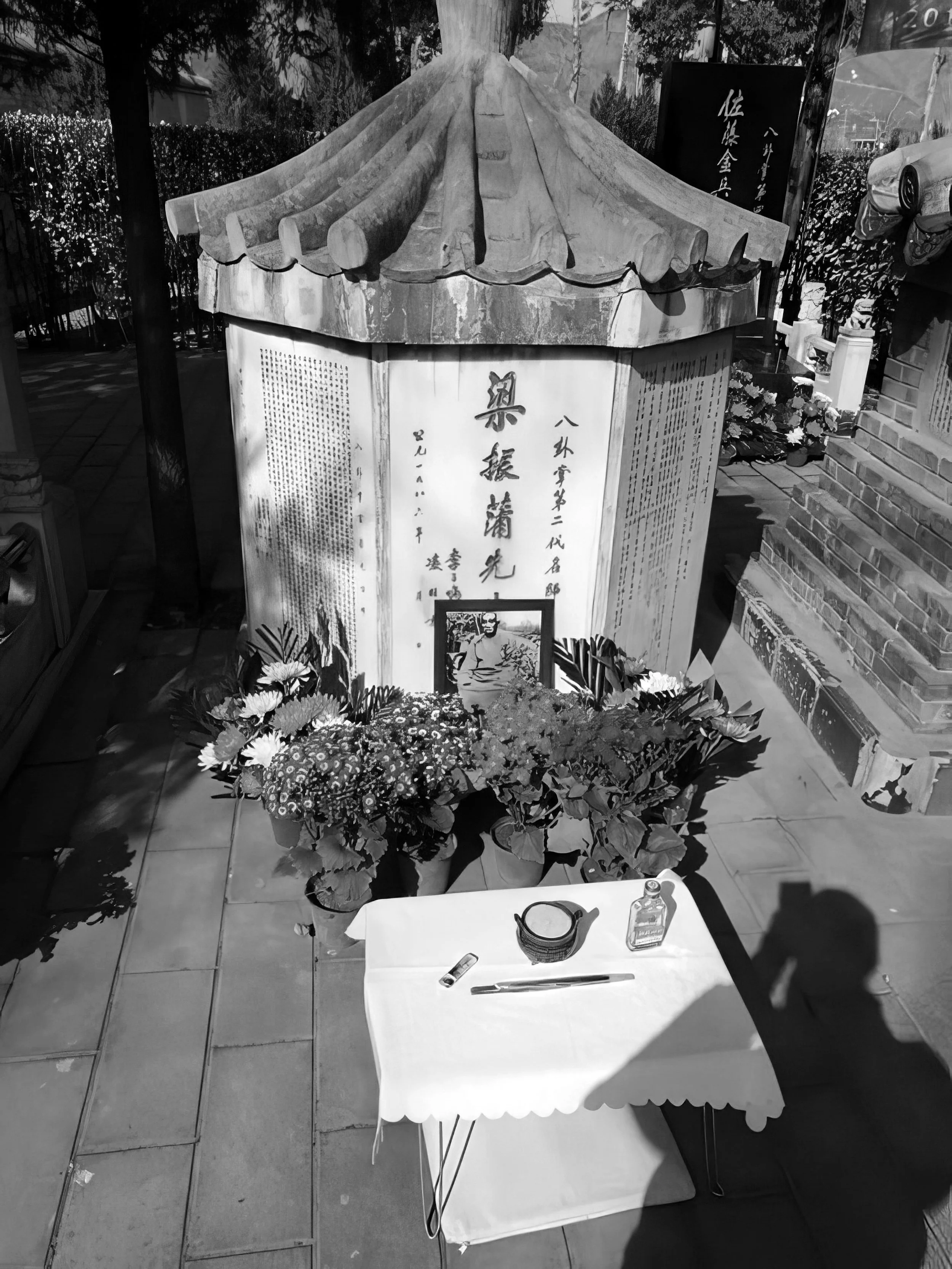
Liang Zhenpu’s tomb at Wan’an Cemetery, Beijing. Li Ziming arranged for the tomb to be relocated there in 1986 after finding the original burial site damaged by flooding.
Assessing Huang Bonian’s Account
While Huang Bonian’s account is lengthy and detailed, some of its claims stand in direct contrast to what we know of Liang Zhenpu’s life. Most striking is Huang’s assertion that Liang never wounded anyone, much less took a life. As I discuss in my biography of Liang, his confrontation with a criminal group at Ma Jiapu in 1900 resulted in deaths and led to his arrest and imprisonment. My grand-teacher, Li Ziming, located records of Liang’s arrest and imprisonment, and the incident was also reported in a newspaper of the time.
Accounts of famed martial artists in Huang’s era often mixed remembered events with embellishment and invented anecdotes about extraordinary feats. We should therefore be careful about taking every detail at face value. At the same time, dismissing the account altogether would mean missing its underlying message. Huang presents Liang as a man whose formidable skill was guided by restraint, generosity and concern for others. Whether or not every episode happened as told, those are the qualities Huang wanted his readers to recognise and aspire to.
Readers interested in a fuller account of Liang’s life can find his biography, alongside biographies of other prominent practitioners of Liang-style Bagua Zhang, in my book Liang Style Bagua Zhang Volume One: Foundational Practices. It is available to order through Mu Shin Martial Culture and Amazon.
I’ll be sharing more biographies from Huang Bonian’s writings, as well as an account of Huang’s own life, in future articles. You can subscribe to my newsletter to know when they are published.

Unlock the secrets of one of China’s most revered martial arts with Liang Style Bagua Zhang, Volume One. Written by renowned 4th-generation master Di Guoyong, this guide explores the foundational practices of Bagua Zhang—a martial art known for its circular movements, unique footwork, and profound internal principles.
This volume covers the origins of Bagua Zhang, the development of the Liang style, and the life of its founder Liang Zhenpu, while tracing the art’s evolution through successive generations. Di Guoyong also shares insights from his training under the legendary Li Ziming, offering a rare, firsthand view into the Liang lineage.
Essential techniques are explained clearly, building a solid base for both beginners and experienced practitioners. Key practices for mastering the Liang system are included, along with an in-depth study of the Eight Fixed Posture Palms. Instructions are supported by detailed illustrations and video references to help readers grasp each movement confidently.
Translated, co-authored, and edited by Byron Jacobs, a 5th-generation practitioner, this book delivers traditional knowledge in a modern, accessible format. Whether refining your skills, exploring Bagua’s roots, or deepening your martial understanding, this volume is an essential resource for serious Chinese martial arts practitioners.
The Liang Style Bagua Zhang series is your trusted companion on the path to mastery—offering clarity, structure, and inspiration every step of the way.
NOTE:
Should your country of delivery not display at checkout, please do contact us directly to process your order.
Should you wish to use expedited delivery such as Fedex etc. please do contact us directly to process your order.
Should you want to order more than one copy of the book in a single order, contact us directly to confirm your shipping cost.
Liang Style Bagua Zhang Volume One: Foundational Practices
Discover the foundations of Liang-style Bagua Zhang in this authoritative guide by fourth-generation master Di Guoyong. Covering the art’s history, lineage, essential training methods and Eight Fixed Posture Palms, the book combines detailed instruction, illustrations and supporting video references.
Translated, co-authored and edited by fifth-generation practitioner Byron Jacobs.