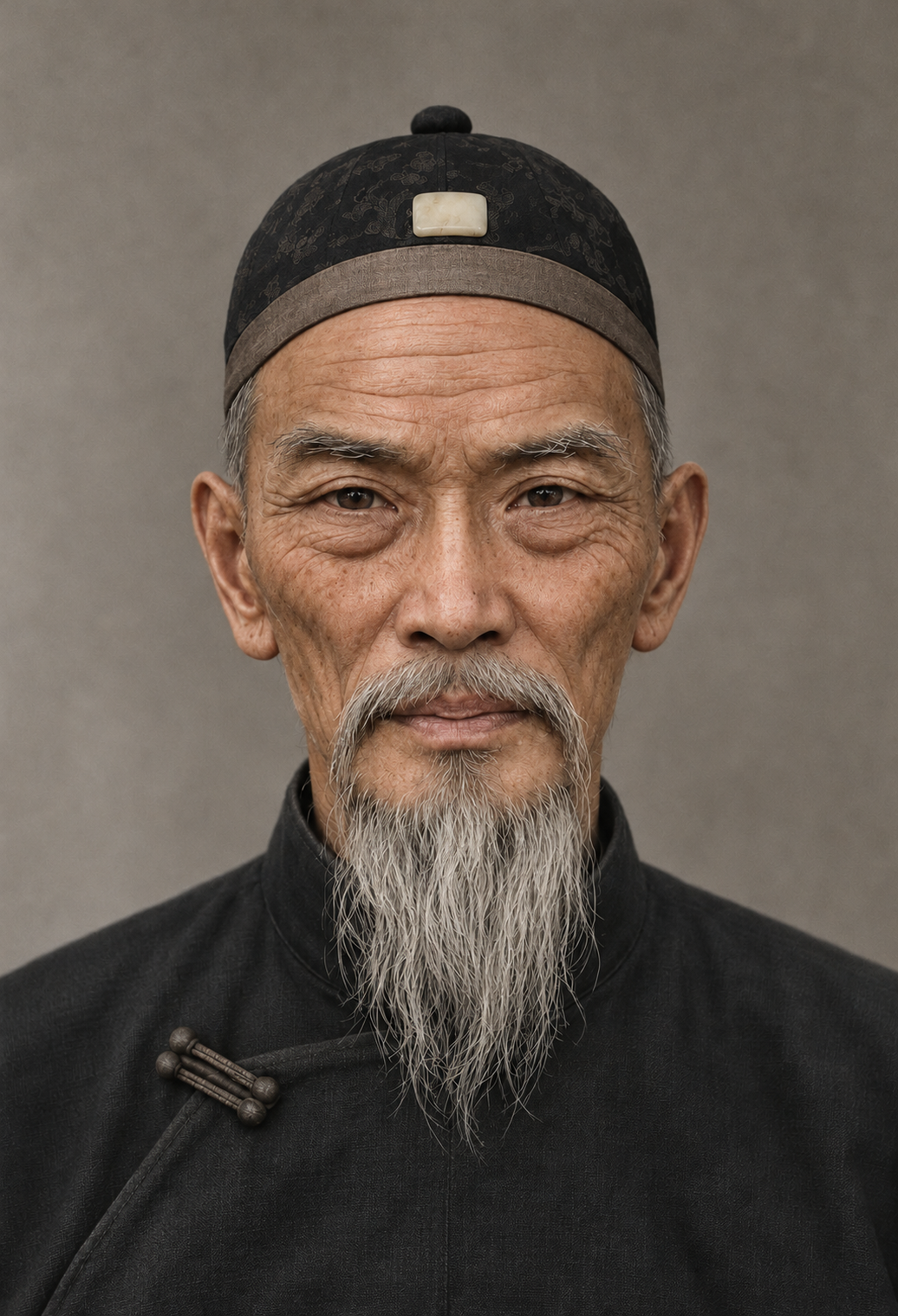
Shi Jidong 1835 - 1908/1909 (reconstruction of Shi Jidong based on a widely circulated sketch)
Shi Jidong (史计栋), courtesy name Zhenbang, was an early disciple of Dong Haichuan and an important figure in the transmission of Bagua Zhang. Originally from Jixian in Hebei province, he initially ran a funerary paper-clothing shop and later operated a wooden-goods business in Beijing and became particularly known for his kicking methods. He also had a close family relationship with his teacher: his wife became Dong Haichuan’s adopted daughter, and accounts describe Shi’s household caring for Dong in his later years.
While reading Chinese material about Shi Jidong, I came across the following article. I found its emphasis on his responsibilities towards his teacher especially interesting. Alongside the familiar accounts of martial skill, it considers the practical support through which a teacher’s knowledge and memory were preserved.
Below is my full English translation. The article contains a mixture of biographical information, stories preserved within the tradition, and the author’s own interpretations as well as the usual splash of story-telling which is part and parcel of martial biographies. After the translation, I offer some comments comparing it with other accounts and highlighting points that deserve further consideration.
Shi Jidong: “Shopkeeper Shi Six,” the Man Who Brought the Founder Home
Translated by Byron Jacobs
In 1909, the first year of the Xuantong reign, several disciples supported a critically ill old man aboard a train travelling from Beijing to Jixian. He was seventy-three. His surname was Shi, and he was the sixth child in his family. In the capital, everyone called him “Shopkeeper Shi Six.”
He had lived in Beijing for forty years. Neither of the two businesses he ran sounded particularly distinguished: in his earlier years, he operated a funerary paper-goods shop, making paper clothing for bereaved families; later, he opened the Yihe Timber Workshop in the eastern part of the city, producing wooden goods. One business attended to the dignity of the dead; the other supplied the household needs of the living.
The last person he saw off was his teacher.
Among the practitioners of Bagua Zhang, there were many formidable fighters. Cheng Tinghua died in the street. Yin Fu taught martial arts in the palace. Ma Gui remained in a small courtyard into old age. Ma Weiqi died suddenly at twenty-nine. Liu Fengchun practised a single movement for nine years. Liang Zhenpu killed a man, went to prison, and walked into the magistrate’s office of his own accord. This article is not about the best fighter among them. It is about the man who brought the founder home.
Xiaozhai Village: Twenty Li of Kicking Practice
He was born in 1837, the seventeenth year of the Daoguang reign, in Xiaozhai Village, Jixian, Hebei. As the sixth child in his family, he was called Shi Six. His given name was Jidong, and his courtesy name was Zhenbang. Later biographies within the tradition invariably began with the same sentence:
“He was sixth in the family, and everyone therefore called him Shi Six.”
Jixian lay in southern Zhili, where many people practised martial arts. As a boy, he studied under Qin Fengyi, a renowned Tantui practitioner from the same county, known as “Iron Legs Qin Fengyi.”
Accounts within the tradition preserve one detail about his training: his home was about ten li (approx. 5km) from his teacher’s residence, and he practised kicks continuously on the journey there and back. After several years, he had acquired everything his teacher had to impart.
Ten li each way: twenty li for the round trip. This was not a matter of setting aside a couple of hours each day to practise boxing. He turned the act of walking itself into training. The “legs” in his later nickname had their roots in those twenty li of road.
Yin Fu was also from Jixian and had also first studied under Qin Fengyi. The two men came from the same place, shared the same teacher, and got along well. Whenever they met, they exchanged skills. This connection would later prove crucial: because Yin Fu took the first step, Shi Jidong was able to take the next.
Incidentally, Liang Zhenpu also began his training under Qin Fengyi, at the age of seven. A single Tantui teacher from Jixian sent three men into Bagua Zhang.
The Funerary Paper-Goods Shop and the Yihe Timber Workshop
After arriving in Beijing, he initially opened a funerary paper-goods shop. These goods included paper clothing used in funeral rites, as well as paper figures, horses, banners, and ceremonial parasols. The trade might appear insubstantial, but it demanded considerable judgment: everything required had to be provided, and nothing essential could be skimped on. Dates, customs, and ceremonial arrangements all had to be correct.
Later, he opened the Yihe Timber Workshop in the eastern part of the city, inside Chaoyang Gate, according to one account, making wooden goods and coffins. People in the capital called him “Shopkeeper Shi Six.”
Accounts within the tradition describe his character in these terms: upright, eloquent, and disinclined to quarrel. When disputes arose among his neighbours, “a single word from him would resolve them.” When disagreements arose between employers and workers in his trade, he was often invited to mediate. Both sides would be satisfied, “and the dispute would cease.”
The two trades had something in common: both involved handling matters that people found especially difficult. When someone died, the bereaved household would be in disarray. Someone had to step forward to arrange the dates, establish the procedures, and keep everything under control.
What he did best throughout his life, then, was not really striking people. It was seeing that things were properly taken care of. This would matter twice later on: once when he brought an old man home, and once when he laid that old man to rest.
Yin Fu Introduces Him to the School
After Qin Fengyi died, Yin Fu became a disciple of Dong Haichuan. When Shi Jidong heard about this, he too entered Dong’s school, introduced by Yin Fu.
The order given within the tradition is Yin Fu as the senior disciple, followed by Ma Weiqi, with Shi Jidong third. Some accounts call him Dong’s “third closed-door disciple.”
By then, Dong Haichuan was already famous throughout the capital. Prince Su had presented him with a plaque bearing the inscription “The Foremost Man of the Great Qing.” Accounts within the tradition say:
“His methods were endlessly varied, and his changes of footwork were especially unfathomable and extraordinary. His reputation filled all nine quarters of the capital.”
Shi Jidong already possessed a substantial repertoire of kicking methods before entering the school. Dong Haichuan did not make him abandon what he had learned. Instead, he had him integrate his kicking into the walking and turning. This was the step that made the Shi tradition distinctive: he brought the skills developed along those twenty li of road in his youth into the circle of Bagua Zhang.
As the tradition puts it, only when Bagua Zhang reached Shi Jidong did its legs truly become rooted in the circle.
“Cunning Legs”: A Nickname Born from the Founder’s Teasing
The origins of the nickname “Cunning Legs Shi Six” were less dignified than those of many martial nicknames.
One day, while Dong Haichuan was instructing him through an exchange, Dong launched a thrusting kick at him. Shi evaded it. Dong laughed and called him:
“Cunning legs!”
That was all it took. He had not invented the name himself, nor had his disciples bestowed it in flattery. It began with a teasing remark from the founder and spread through the school until he became known as “Cunning Legs Shi Six.” His fellow disciples accepted it too: there were not many people who could evade a kick from Dong Haichuan.
Accounts within the tradition describe his training quite specifically. When practising his stepping, he kept his buttocks lower than his knees, regardless of summer heat or winter cold. He would often train until sweat seeped from his body and fell in thick, sticky beads. The detail is somewhat sensational, but its point is the sheer volume of practice: he did not merely go through a routine once; he trained until he reached that state.
Two other practices are recorded. Every morning, he went to the foot of the eastern city wall and struck his body against it, continuing without interruption for decades. At home, he kept a pellet bow hanging from a roof beam. He would take it down when needed and shoot pellets at targets, never missing.
These methods look severe today, but they all point towards the same quality: his kicks were not simply “fast”; they were “unexpected.” Later, the Shi tradition expressed its standard for kicking in a single sentence:
“When I kick, the person being kicked should not know how that leg came out.”
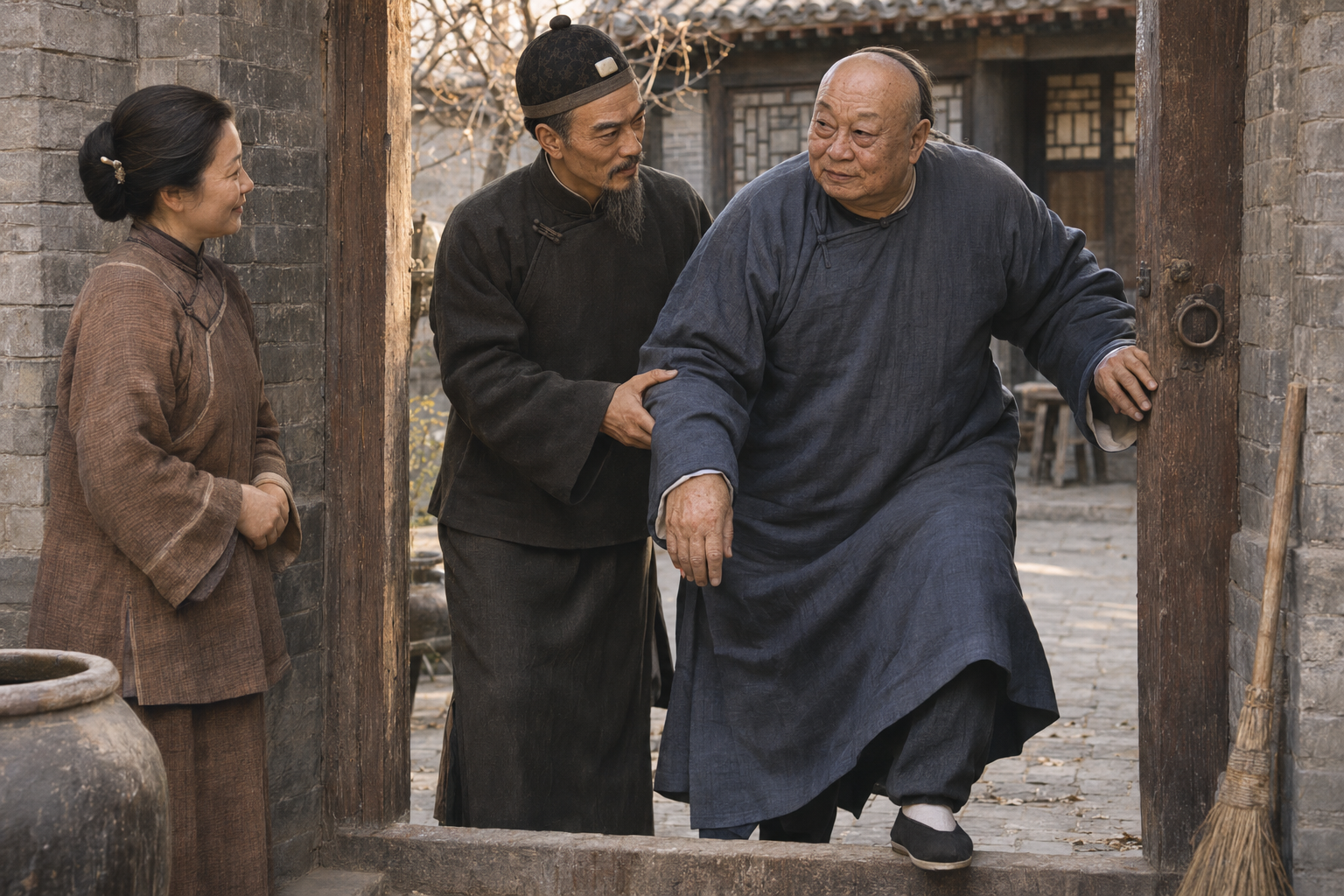
An imagined scene of Shi Jidong and his wife welcoming the elderly Dong Haichuan into their Beijing home (Digital Recreation)
He Brought the Founder Home
In Dong Haichuan’s later years, he had no one to care for him. Shi Jidong brought him into his own home and personally attended to his needs.
Under the conventions of the time, unrelated men and women were expected to avoid close physical contact. To make it easier for his wife to care for Dong’s daily needs, Shi had her formally acknowledge Dong as her adoptive father. Through this act, Shi Jidong became Dong’s “adoptive son-in-law.” The tradition describes their relationship as “closer than that of a son-in-law by marriage.”
Moved by his devotion, Dong Haichuan “imparted his entire art without reserve.” An old man in his seventies had only one thing left to give: the skill embodied in him. He gave it all.
A passage in Guo Gumin’s surviving writings records the sequence of Dong’s residences, placing this episode in a clear context:
“Our grandteacher first moved to Teacher Liang Zhenpu’s residence in Nanchuanban Hutong, Beixinqiao, where he taught. He then moved to Senior Brother Ma’s timber workshop on Chaoyangmen Street. Three years later, he moved again, to Senior Uncle Ma’s coal shop inside Dongbian Gate. He subsequently moved to Senior Uncle Shi’s residence at Dongsi Pailou. Within a few years, our grandteacher passed away.”
Taken together, these place names trace Dong Haichuan’s movements during his final years. The founder of a martial tradition spent his old age moving between the homes and premises of disciples who ran shops: Liang Zhenpu’s home, Ma Gui’s timber workshop, Ma Weiqi’s coal shop, and Shi Jidong’s home. Timber workshops feature twice in the broader account.
Who ultimately receives a person’s knowledge depends not only on who is willing to practise, but also on whose courtyard has room to accommodate him.
A Funeral and a Stone Inscription
Dong Haichuan died in 1882. Shi Jidong handled the arrangements: organising the funeral and burial, and erecting a commemorative stele.
The following year, in the second lunar month of the spring of 1883, the ninth year of the Guangxu reign, fifty-six disciples erected a stele before his grave in Xiaoniufang Village, outside Dongzhi Gate.
Its inscription is the earliest surviving account of Dong Haichuan’s life. It identifies him as a native of Zhujiawu, south of Wen’an, and describes him as a chivalrous young man. In middle age, he “followed the precedent of Sima Qian” and entered the service of Prince Su’s household. It states:
“During his time, he taught thousands of people his art, ranging from scholars to merchants and even officials, each learning a unique skill”
Of his final moments, it records:
“While on his deathbed, his followers came to touch his hands and feet. Dong resisted death for three days like a man of iron and then passed away as lightly as a feather.”
And:
“On the day of his funeral, his disciples along with hundreds of others, all dressed in white - followed his funeral procession”
Today, that stone remains one of the firmest pieces of evidence available for discussing the origins and transmission of Bagua Zhang.
There was something almost inevitable about a man who had made funerary paper goods and operated a timber workshop taking charge of this task. He knew how to select a coffin, how to erect a stele, whom to ask to compose the inscription, and in what order the fifty-six names should appear.
In 1983 Li Ziming and others proposed relocating the grave to Beijing’s Wan’an Cemetery. The steles were moved too, and a larger collection of commemorative steles gradually developed there.
The stele he erected for the founder later became a genealogical record for the entire tradition. More than half the dates, teacher–disciple relationships, and names discussed in the preceding articles can be traced back to that stone.
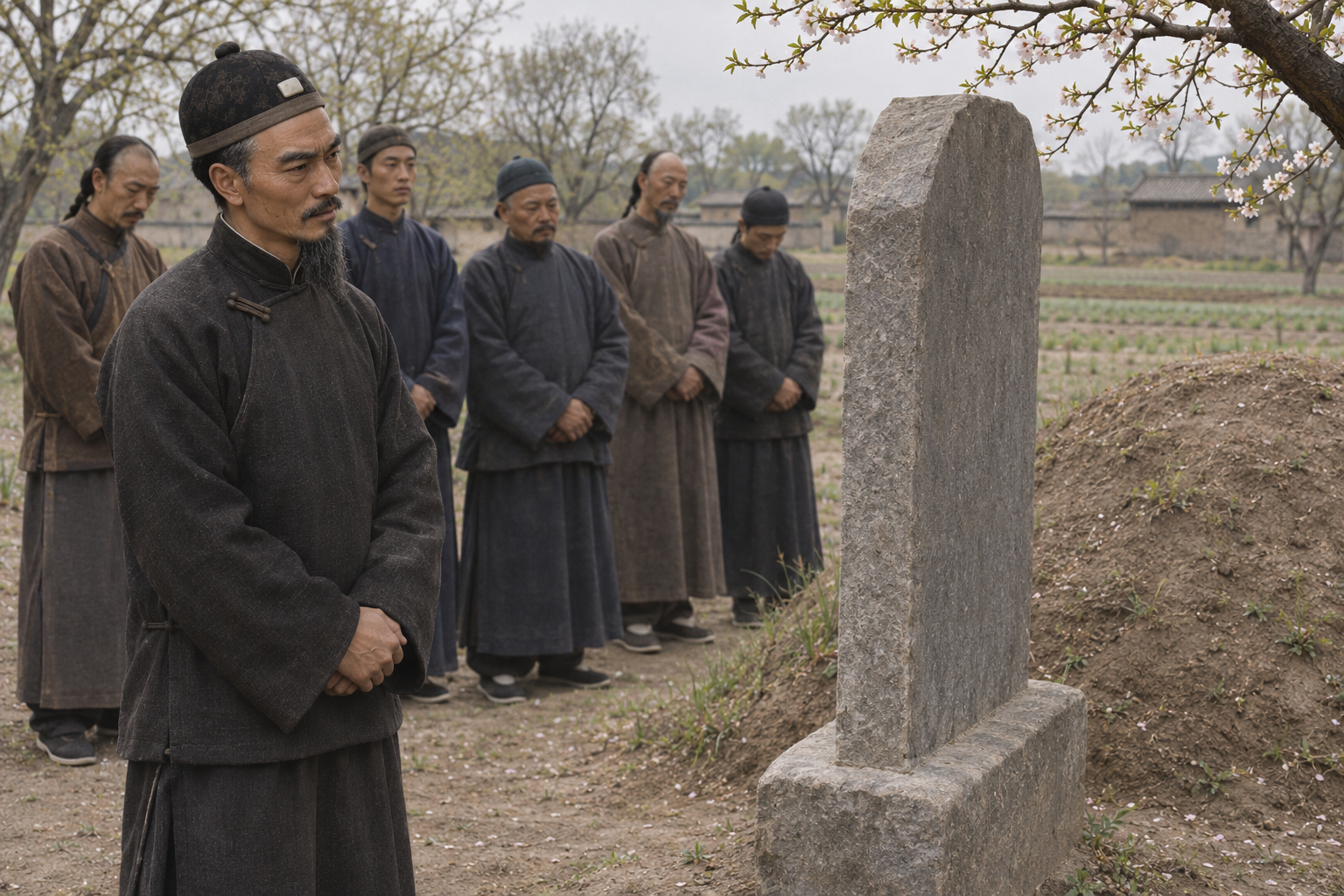
An imagined gathering of Shi Jidong and fellow disciples at Dong Haichuan’s memorial in spring 1883. (Digital Recreation)
The Bandit Stronghold and the Official’s Hat
Near the capital, a band of robbers had established a mountain stronghold. They plundered travellers, stole their possessions, and killed people. The local authorities had been unable to capture them. Someone approached Shi Jidong for help, and he agreed.
He took his disciples with him, captured eleven ringleaders, and destroyed the stronghold. The Qing court rewarded him with the hat insignia of a sixth-rank official.
Another account says that, “for meritorious service in carrying out official duties, he was granted the title of fourth-rank armed imperial guard during the Tongzhi reign.” These two versions differ substantially; they will be considered again in Section 10.
A shopkeeper who ran a timber workshop received an official distinction from the court through getting a job done, rather than through success in the military examinations. Afterwards, people in the capital saw him differently. He was no longer simply “that shopkeeper at the timber workshop who knows how to fight,” but “a man who can get things done.”
A Visit from a Iron-Palm Expert
The tradition records another incident. One day, a martial artist renowned for his iron-palm training came to visit. Shi Jidong and his disciples met him at the entrance and led him inside.
Beside the entrance stood a stack of bricks—or, in another version, a stone stele. Wishing to display his ability, the visitor struck it with his palm, shattering the bricks. The demonstration carried a message: my hand can break bricks; can your body withstand it?
After they entered the house and exchanged courtesies, the visitor requested a match. Shi Jidong did not take part himself, but sent out his disciple Yang Rongben.
Yang saluted with clasped hands, and the two adopted their positions. The visitor advanced with a punch. Yang withdrew slightly, avoiding the attack. When the visitor advanced again, Yang turned with an toe-out hooking step (Bai Bu), bent forward, and delivered a rear thrust kick. The visitor staggered more than a zhang (approx. 3 meters) backwards and fell to the ground. Shi Jidong immediately had someone help him up. The visitor departed in embarrassment.
Afterwards, someone told Shi what had happened to the bricks at the entrance. He said:
“Methods such as iron-palm training have their uses: they increase striking power and improve one’s ability to withstand pain. But unless they are applied through practical fighting skill to secure victory, they may not achieve the desired result.”
Hard conditioning has its uses, but it is not in itself the means to victory. Coming from him, the observation carried particular weight: he had made his reputation through kicking methods, rather than hard conditioning.
The Eastern City School
Because he lived in the eastern part of the city, his art became known as the “Eastern City School of Bagua Zhang.” It was celebrated in the capital alongside Cheng Tinghua’s Southern City School.
Its characteristic hand shape is the hook-sickle hand: the index and middle fingers are held together, the tiger’s mouth is spread open, the thumb hooks inward, and the remaining two fingers curve slightly inward. According to the tradition, this shape facilitates “hooking above and securing below, intercepting in front and drawing in behind.”
Its footwork includes mud-wading steps and chicken-shape steps, using outward and inward hooking steps to walk and turn around the circle.
Its technical framework comprises eight characters representing eight methods: pushing, lifting, carrying, leading, moving, blocking, hooking, and intercepting. It also includes five animal forms and their associated configurations: dragon, tiger, monkey, snake, and swallow.
Each of the eight methods constitutes one section, making eight sections in total. Each section contains eight palms, making sixty-four palms. Each palm contains multiple configurations, with the five animal forms running throughout. They are practised on both sides, changing as one moves around the circle.
Its principles are expressed in three statements:
“Avoid the direct line and strike obliquely; use the orthodox to overcome the unorthodox.”
“Take movement as the foundation and change as the method.”
“Neither parry nor block; draw the opponent in and let the attack fall into emptiness.”
The aim is to avoid contesting strength with the opponent and instead cause the opponent’s own force to lose control.
Within the tradition, the greatest emphasis is placed on the legs: isolated practice and practical application, developed until the kicks are “cunning, elusive, and extraordinarily fast, never failing to hit.”
When Guo Gumin used eight-character descriptions to summarise the different branches, the phrase he assigned to Shi Jidong was “toe-out and toe-in hooking steps linked continuously.”
Among Shi’s prominent Beijing disciples were Sun Yuelou, Han Fushun, Zhang Dexiu (Shanting), Yu Qingjin, Yang Rongben, and Shoushan.
Han Fushun excelled in Bagua sabre methods and practical fighting. On making contact, he could send someone two or three zhang out. Han taught Wu Junshan, who was skilled in Liuhe Quan and later also received instruction from “Great Spear Liu,” Liu Dekuan, who gave him a Bagua Zhang manual. Wu taught at martial arts institutes for many years. Later, when the Central Guoshu Institute moved to Yunnan, the Shi tradition spread there.
The Hengshui line, meanwhile, runs from Shi Jidong to Sun Yuelou, from Sun Yuelou to Sun Dayou, and from Sun Dayou to Wang Muhang, continuing to the present.
His art did not disappear. It divided into several streams, each continuing along its own course.
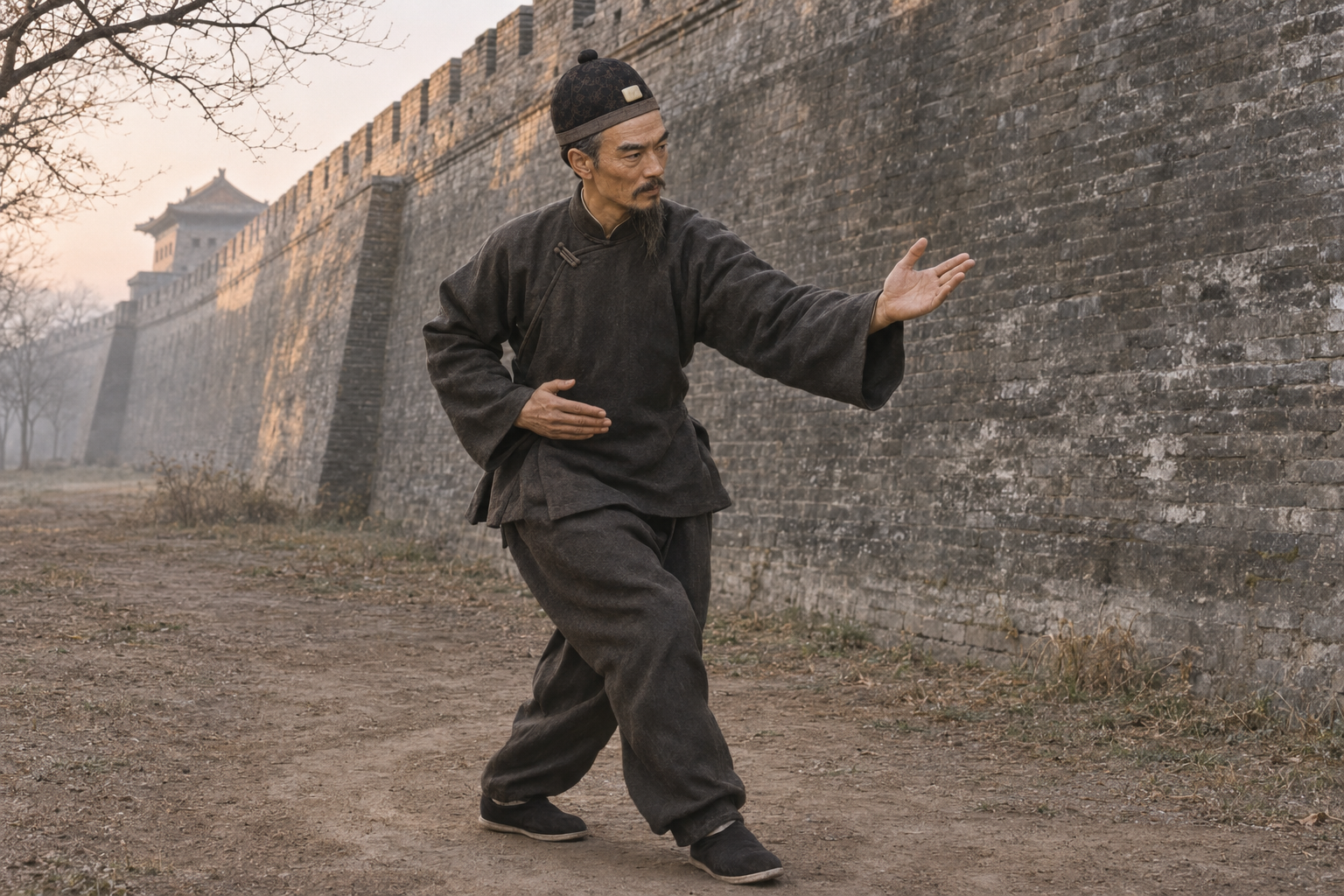
Shi Jidong practising beside Beijing’s eastern city wall, an imagined scene inspired by accounts of his training. (Digital Recreation)
Commentary: Comparing the Accounts
The article above offers an engaging portrait of Shi Jidong, particularly through its emphasis on his care for Dong Haichuan. However, it also combines biographical claims, stories preserved within the tradition, and the author’s own narrative interpretations. Comparing it with other accounts helps identify where its information is supported, where versions differ, and where further context is useful.
A Family Account of Dong Haichuan’s Care
An important source is an article by Shi Naijian, who identifies himself as a direct descendant of Shi Jidong. Published in Zhonghua Wushu, issue 149, December 1996, it is in part available in English on the Smiling Tiger website.
Shi Naijian states that the family accommodated Dong Haichuan and provided his clothing, food, and expenses, subsequently arranging his tomb. He also explains that Shi’s wife became Dong’s adopted daughter so that the household could appropriately attend to his needs under the social conventions of the time.
This supports the central account of Shi’s responsibilities towards his teacher. It remains retrospective family testimony, but it gives us a named and dated source for details repeated in later biographies.
Some of the translated article’s more specific suggestions go beyond this testimony. Its description of Shi knowing whom to commission to write the inscription and how to arrange the fifty-six names is evocative, but the sources considered here do not establish that he personally made those decisions. His involvement in Dong’s funeral and commemoration should be distinguished from the author’s reconstruction of how he might have managed them.
Shi Jidong and Shi Liqing
The article mentions “Shi Liqing” as a possible martial name but leaves its origins unresolved. Shi Naijian addresses this directly, identifying Shi Liqing as Shi Jidong’s martial name.
His article was written partly to correct confusion in earlier publications. It distinguishes the surname 史, pronounced Shǐ, from 施, pronounced Shī, and challenges an account that presented Shi Jidong and Shi Liqing as separate teachers. The confusion is particularly easy to perpetuate in English, where both surnames are commonly written “Shi” without tone marks.
Shi Naijian’s account therefore provides a specific attribution for the identification of Shi Liqing with Shi Jidong, rather than leaving it as an unexplained alternative name.
Han Fushun’s Relationship with Dong Haichuan
The translated article lists Han Fushun among Shi Jidong’s disciples but does not discuss the competing accounts of his relationship with Dong.
Shi Naijian describes Han as a blacksmith employed at the family’s Yihe lumberyard. Because Dong lived with the family, Han had opportunities to receive corrections from him. However, Shi Naijian disputes the claim that Han formally became Dong’s disciple, citing the absence of his name from the tomb inscription.
This raises a useful distinction between receiving instruction from a teacher and formally entering that teacher’s lineage.
Dates and Historical Certainty
The sources give three combinations of Shi’s birth and death years: 1837–1909, 1835–1908, and 1835–1909. Shi Naijian and Masters of the IMA give 1837–1909; the additional Chinese biographical passage gives 1835–1908; and the Baidu entry gives 1835–1909. The article and other accounts assembled here do not resolve them.
Similar caution applies to the official rank attributed to Shi and to stories of bandit suppression and extraordinary training feats. The original author acknowledges several uncertainties, which is welcome. Nevertheless, agreement between later accounts may reflect their use of shared material rather than independent evidence.
The article’s emphasis on the practical responsibilities of discipleship is valuable. Shi Naijian’s family account gives that theme a more specific source, while the other accounts broaden our understanding of Shi’s methods and their subsequent transmission. Together, they allow us to appreciate the narrative while remaining clear about which details are documented, attributed, disputed, or still unresolved.
Closing
Shi Jidong was an important figure in the history of Bagua Zhang: a highly skilled practitioner who contributed much to the art’s development and transmission. Despite the uncertainties surrounding some details of his life, this article offers a valuable introduction to his character, his martial practice, and his relationship with Dong Haichuan. In a future blog article, I will explore subsequent practitioners of Shi-style Bagua Zhang and their contributions to preserving and spreading the art.
References
Shi Naijian. “Shi(3) Jidong Is Not Shi(1) Jidong.” Zhonghua Wushu, issue 149, December 1996. English translation hosted by Smiling Tiger Martial Arts. A descendant’s account addressing Shi Jidong’s names, his household’s care for Dong Haichuan, and Han Fushun’s relationship with the family. English translation.
“Shi Style Baguazhang of Di Zhaolong.” Masters of the IMA, 5 January 2018. Biographical and technical account covering Shi Jidong and the transmission through Yang Rongben to Di Zhaolong. Article
“Shi-style Baguazhang” (史氏八卦掌). Baidu Baike, entry 110130. Overview of the tradition’s history, technical characteristics, transmission lines, and intangible cultural heritage recognition. Entry.
These sources include retrospective family testimony, lineage accounts, and modern summaries. Their agreement should not automatically be understood as independent corroboration; differences between them are discussed in the commentary.

Liang Style Bagua Zhang Volume One: Foundational Practices presents the history, principles and essential training methods of Liang Style Bagua Zhang. Written by fourth-generation master Di Guoyong and translated, co-authored and edited by his disciple Byron Jacobs, this volume provides a structured introduction to the system and its traditional practice.
The book traces the origins and development of Bagua Zhang before examining the formation of the Liang style through its founder, Liang Zhenpu. It follows the transmission of the system through successive generations and includes Di Guoyong’s personal account of studying under the renowned master Li Ziming.
The instructional chapters introduce the fundamental practices used to establish the body method, stepping, coordination and principles required for further study. Particular attention is given to the Eight Fixed Posture Palms, an important foundational practice within Liang Style Bagua Zhang.
Clear explanations, detailed illustrations and supporting video references help readers study the movements and underlying principles. The material is suitable both for practitioners beginning their study of Liang Style Bagua Zhang and for experienced martial artists seeking a deeper understanding of the system’s foundations and lineage.
This volume includes
The origins and historical development of Bagua Zhang
The life of Liang Zhenpu and the formation of the Liang style
The transmission of the Liang lineage through successive generations
Di Guoyong’s experiences studying under Li Ziming
Essential principles and foundational training methods
Detailed instruction in the Eight Fixed Posture Palms
Illustrations and supporting video references
Book details
Authors: Di Guoyong and Byron Jacobs
Language: English
Paperback: 224 pages
Interior: Black and white
Dimensions: 156 × 234 × 14 mm
Weight: approximately 480 g
ISBN: 978-9925-8003-4-6
Publication date: May 2025
Shipping and combined orders
If your delivery destination is not available at checkout, please contact us directly. Expedited delivery options such as FedEx may also be arranged on request.
For orders containing multiple books, contact us before purchasing so that we can confirm the most suitable combined shipping rate.